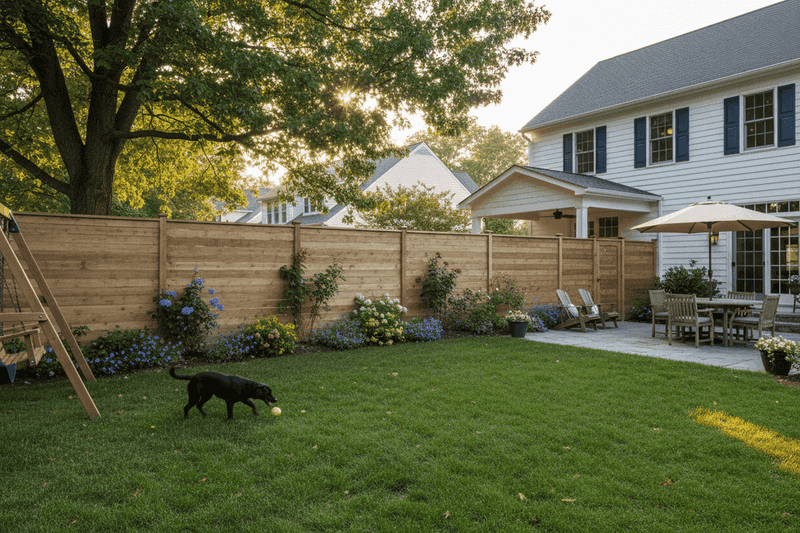
A horizontal fence runs its boards side to side instead of up and down, and built right in cedar it can last 15 to 30 years, or up to 40 years with regular sealing. That clean, modern look is everywhere right now, but the result you are picturing only holds up when it is built in the right wood, set on the right posts, and fastened so it stays dead straight through our wet Northwest weather.
This guide covers what a horizontal fence is, why so many Portland-area homeowners are choosing it in 2026, and the cedar designs that look best and last longest here. When you are ready to talk through your own yard, our team builds custom horizontal cedar fences across the Portland metro and Southwest Washington.
What Is a Horizontal Fence?
A horizontal fence is exactly what it sounds like. Instead of the traditional vertical pickets you see on most older fences, the boards run flat and parallel to the ground, stacked from the bottom of the panel to the top.
That one change does a lot of work visually. Horizontal lines make a yard feel wider and more open, they read as modern and architectural rather than rustic, and they pair cleanly with the flat rooflines and clean trim you see on newer and remodeled Portland homes.
The structure underneath is different too, and this is where build quality matters most. A horizontal fence still relies on strong, deep-set vertical posts, but the boards span the gaps between those posts horizontally. Get the posts, the spacing, or the fasteners wrong and the fence will sag, cup, or streak with rust over time. Done right, it stays straight and tight for decades.
A few quick terms you will hear:
- Posts: the vertical members set in concrete that hold everything up. We use heavy-duty pressure-treated posts or a steel post upgrade for full rot resistance.
- Boards or slats: the horizontal cedar pieces that make the face of the fence.
- Gap or reveal: the small space left between boards. A light gap of roughly 1/8 to 1/4 inch lets cedar expand and contract with moisture so it does not warp or buckle.
- Top rail cap: a finishing piece along the top that shields the end grain from water, keeps boards from cupping, and gives the fence a clean edge. It is our most popular add-on.
Why Horizontal Fences Are So Popular Right Now
Horizontal fencing has moved from a designer trend to one of the most-requested styles we build, and there are real reasons behind it, not just looks.
It matches modern home design. Clean horizontal lines complement the contemporary and mid-century-modern homes going up around Portland, Lake Oswego, and the close-in neighborhoods. A horizontal fence finishes that look in a way a standard picket fence cannot.
It makes a yard feel bigger. Horizontal lines draw the eye sideways, which makes a space read as wider and more open. On a smaller city lot, that is a real advantage.
It still gives you privacy. Because the boards stack tightly with only a small gap, a horizontal fence blocks sightlines just as well as a traditional privacy fence, while looking more like a designed feature than a barrier.
It feels custom. You choose the board width, the spacing, the height, and the finish, so the fence suits your home instead of looking like a stock panel.
The catch, and the reason this style is worth hiring a real fence contractor for, is that horizontal fences are far less forgiving than vertical ones. The boards want to sag between posts, cheap builder-grade cedar cups and twists in our climate, standard nails leave rust streaks down a light cedar face, and sloppy spacing shows badly on a long run. The modern look only stays modern when the build is right.
Horizontal vs Vertical: What Actually Changes
If you are deciding between a horizontal fence and a traditional vertical one, here is the honest side by side:
| Horizontal cedar | Vertical cedar | |
|---|---|---|
| Look | Modern, architectural | Classic, traditional |
| Makes a yard feel | Wider and more open | Taller and enclosed |
| Privacy | Excellent with a tight gap | Excellent |
| Sag and warp risk | Higher if under-built, so cedar grade and post spacing matter | Lower and more forgiving |
| Best cedar | Grade 1 or Clear, since straight grain matters most here | Grade 1 cedar |
| Build complexity | More involved | Simpler |
Neither is better in the abstract. Horizontal wins on a modern look and making a space feel bigger, vertical wins on simplicity. The key with horizontal is that it has to be built right, which is what the rest of this guide is about.
Materials and Design Ideas: Why We Build Horizontal Fences in Cedar
We build our horizontal fences in cedar, and we do not cut corners on the grade. Every Gorilla Works fence uses Grade 1 cedar or better as the standard, with Clear Cedar available as an upgrade. A lot of fence companies start you on cheaper builder-grade or knotty cedar and then charge extra for Grade 1. We do not.
That matters more on a horizontal fence than almost anywhere else. Higher-grade cedar has minimal knots, a cleaner grain, and far less tendency to warp, cup, or twist. On long horizontal runs, where every board is at eye level and straight lines are the whole point, that stability is the difference between a fence that still looks sharp in ten years and one that goes wavy in two.
A few more reasons cedar is the right call here in the Pacific Northwest:
- It resists rot, moisture, and insects naturally, which is exactly what you need in a climate that rains as much as ours.
- It looks the part. The warm grain reads beautifully in long horizontal runs, whether you let it silver naturally or seal it to hold its color.
- It lasts. Built well in cedar, a horizontal fence can last 15 to 30 years, and up to 40 years when you seal or stain it every few years.
How we build it to stay straight:
- Heavy-duty posts. We set pressure-treated posts, or you can upgrade to steel posts for no wood rot ever. Our steel posts are rated to withstand wind gusts up to 100 MPH and can be wrapped in matching cedar so both sides look identical.
- Stainless steel nails and fasteners on every cedar install, at no extra charge. Standard nails rust and bleed dark streaks down a fence, which looks especially bad on a clean horizontal cedar face. Stainless steel does not do that.
- A top rail cap to shield the end grain, lock the boards against cupping, and finish the top edge.
A note on materials, so we are straight with you: you will see horizontal fences online in metal, composite, and vinyl. We build the horizontal style in cedar, because cedar is what delivers that look and lasts here. If you want vinyl or chain-link, we install those too, in their traditional vertical form.
The 5 Horizontal Cedar Looks We Build
Horizontal is a category, not a single design. Here are the five looks we build most, from full privacy to airy and architectural:
- Tight-Gap Privacy: boards stacked with a minimal reveal for a solid, modern wall of cedar. The most popular choice for back yards.
- Slat-Reveal: an even, slightly wider gap for a lighter, architectural feel that still screens the yard while letting some air and light through. Great for side yards and patio screens.
- Mixed-Width: alternating wider and narrower boards for texture and a high-end, custom look. Clear Cedar shines here.
- Steel-Post Good-Neighbor: hidden steel posts wrapped in matching cedar so both sides look identical, ideal for windy lots and long runs that have to stay perfectly straight.
- Open Screen: a wider gap for a breezy garden-divider or front-yard accent that filters sightlines instead of blocking them.
The single biggest design choice is the gap between the boards, called the reveal. It sets how private, how airy, and how modern the fence looks. Here is the cheat sheet we walk homeowners through:
| Board gap (reveal) | The look | Privacy | Air & light | Best for |
|---|---|---|---|---|
| 1/8 in to 1/4 in | Solid, modern wall of cedar | Full | Minimal | Back yards, street-facing privacy |
| 1/2 in to 3/4 in | Clean slatted lines | High, slight peek at an angle | Moderate | Side yards, pool and patio screens |
| 1 in to 1 1/2 in | Airy, architectural screen | Partial | High | Garden dividers, front-yard accents, windy spots |
Two finishing touches we recommend on almost every horizontal fence: a top rail cap to shield the end grain and keep boards from cupping, and a kick board along the bottom that stops pets from digging under and protects the cedar from ground moisture. From there you can seal it to lock in the fresh-cedar tone or let it weather to a soft silver-gray. Either way, staining extends its life.
Built by a Crew You Can Trust
A horizontal fence is only as good as the people setting it. Every Gorilla Works installer is an experienced fence specialist, not a handyman, with a minimum of five years of fencing experience. Our crews are background-checked, drug-tested, and run a quality checklist on every job. We are fully licensed, bonded, and insured, we keep job sites clean, and we do not take shortcuts.
We stand behind the work, too. Cedar fences carry a 3-year workmanship warranty, metal posts carry a limited lifetime warranty, and every install includes one year of free gate adjustment. If something is not right, we make it right, fast. Our team has built more than 100 fences across the Portland area that are now over 20 years old and still standing strong.
Frequently Asked Questions
How long does a horizontal cedar fence last?
An untreated cedar fence typically lasts 15 to 30 years, and a sealed or stained one can last up to 40 years. Cedar's natural resistance to rot and insects, paired with Grade 1 or better lumber and stainless steel fasteners, is a big reason our fences hold up so well in the wet Northwest climate.
What kind of cedar do you use for horizontal fences?
Grade 1 cedar or better on every install, with Clear Cedar available as an upgrade. Higher-grade cedar has fewer knots and stays straighter, which matters a lot on long horizontal runs where any warping shows. We do not use cheap builder-grade or knotty cedar.
Are horizontal fences more expensive than regular fences?
A horizontal fence is a more involved build, since it needs careful post setting, quality cedar, and the right fasteners to stay straight, so it sits above a basic vertical fence. We offer flexible financing, including 12-month no-interest options on approved plans, so you can get the fence you actually want now. Reach out and we will give you a real number for your yard.
Why cedar instead of metal or vinyl for a horizontal fence?
Cedar is naturally rot- and insect-resistant, stays straight in our climate when you use the right grade, and looks the best in long horizontal runs. We install vinyl and chain-link too, in their traditional vertical form.
Is a horizontal fence better than a vertical fence?
Neither is better across the board. Horizontal looks more modern and makes a yard feel wider, while vertical is simpler and more forgiving to build. Horizontal does demand a higher grade of cedar and careful post spacing to stay straight, which is why build quality matters more with this style.
What board gap should I use for a horizontal privacy fence?
For full privacy, a tight reveal of about 1/8 to 1/4 inch gives you a solid wall of cedar while still letting the wood breathe. Wider gaps of 1/2 inch or more create a lighter, slatted look that screens the yard but lets some air and light through. The reveal cheat sheet above matches the gap to the look you want.
Do horizontal fences sag over time?
A poorly built one can, because the boards span horizontally between the posts. A properly built one does not. We prevent sag with deep-set posts, correct post spacing, straight Grade 1 or Clear cedar, and stainless fasteners, so the lines stay true for the life of the fence.
How tall can a horizontal fence be in Portland?
In most Portland-area residential zones, back and side yard fences can be up to 6 feet and front yard fences are usually limited to around 4 feet, with extra sight-line rules on corner lots. Limits vary by city and lot, so we confirm the rules for your address before we build.
Can you build a horizontal fence on a sloped yard?
Yes. On a slope we step the fence down in level sections so the horizontal lines stay clean while the bottom follows the grade. It takes more planning than a flat lot, which is exactly the kind of thing our crew handles every day.
What areas do you build horizontal fences in?
We build across the Portland metro and Southwest Washington, including Portland, Gresham, Beaverton, Hillsboro, Tigard, Lake Oswego, Happy Valley, Milwaukie, Troutdale, Vancouver WA, and Camas WA.
The Bottom Line
A horizontal fence gives you a clean, modern, private yard that makes your space feel bigger and finishes off a contemporary home. The look is popular for good reason, but it only stays straight and beautiful when it is built right: deep-set posts, the right grade of cedar, stainless fasteners, and a crew that knows the style.
If you are picturing a horizontal cedar fence for your yard, our local, family-owned team will design it around your home and give you a free, no-pressure quote, with flexible financing available. See our fence installation services or call (971) 343-4964. Gorilla Built. Gorilla Strong.
Want a horizontal cedar fence that stays straight?
Horizontal boards are less forgiving than vertical ones, so post spacing, board thickness and a top rail cap matter more. We build them in Grade 1 cedar on heavy duty pressure treated or lifetime steel posts.
Grade 1+ cedar on every install · stainless fasteners · 3-year workmanship warranty