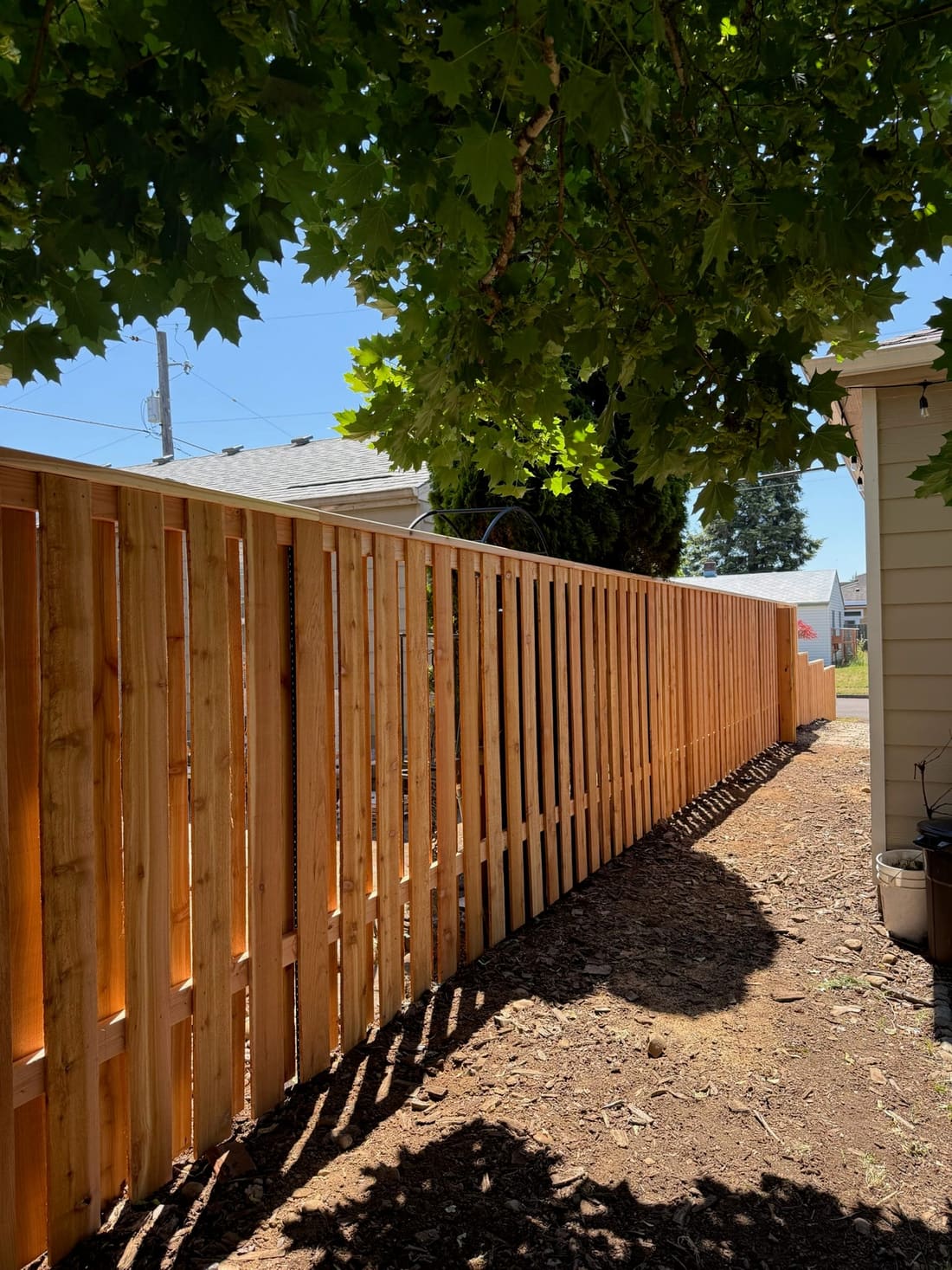
Short answer: no, the common striped skunk cannot climb a smooth, solid fence, though it can work its way up chain link or wire mesh. A smooth barrier 2 to 3 feet tall stops it, it can only jump 6 to 12 inches, and it gets into yards by digging under the fence instead. The smaller spotted skunk is the exception and can climb fences and trees. So if a skunk keeps showing up in your Portland yard, the fix is almost always at the bottom of the fence, not the top.
That one fact changes how you build a fence that actually keeps critters out. At Gorilla Works we build cedar privacy fences designed to close off the gaps at ground level, where skunks and other diggers get in. Here is what is really going on, and what works.
Do Skunks Climb or Dig?
They dig. It comes down to the species:
- Striped skunks (the common black-and-white kind across the Portland metro) are poor climbers. Their long front claws are made for moving dirt, and those same claws get in the way of climbing. So a striped skunk goes under a fence, not over it.
- Spotted skunks are smaller, less common, and they actually can climb trees and fences. They are the exception, not the rule.
So for the skunk most Portland homeowners deal with, the weak point in your fence is the gap at the bottom, not the height.
Are skunks good climbers?
Striped skunks are not. Spotted skunks are. Since that split decides everything else on this page, it is worth knowing exactly how far each one can actually get.
The mechanism is the claw. A striped skunk carries long, fairly straight front claws that are superb excavation tools and close to useless for gripping, on a body that is heavy for its size. It cannot hold itself against a smooth vertical surface at all. A solid barrier of two to three feet turns one away. A spotted skunk is a fraction of the weight with shorter, sharper, more curved claws, and it can climb fences and trees.
Can skunks climb trees?
Spotted skunks, yes, and well. They climb trees comfortably and descend head first, which is unusual and a good field clue if you ever see it. Striped skunks rarely climb trees and are poor at it when they try.
This matters more than it sounds around Portland, because a mature tree or a tall shrub growing next to a fence is a bypass. The animal never touches your fence. It goes up the tree and down the other side. If you are fighting a persistent critter problem, look at what is growing within a few feet of the fence line before you assume the fence failed.
Can skunks climb walls and brick?
Smooth is the deciding factor, not material. A finished concrete wall, smooth block, or a well-sealed board fence gives claws nothing to catch and stops both species. Rough brick with deep mortar joints, stacked stone, and anything with a texture that offers toe holds is a different matter, and an agile spotted skunk can work its way up it.
Can skunks jump?
Barely. A healthy adult skunk manages something like a six to twelve inch vertical hop. It cannot clear a three foot fence by jumping, and it will not clear yours. Jumping is not the way in. If you are trying to work out how something got past a fence, the honest shortlist is under it, through a gap in it, or over something else that happened to be leaning against it.
The fence material decides more than the height
Here is the part that surprises people. Chain link is a ladder. The mesh is a grid of perfect toe holds, and a determined skunk can work up it using its claws and snout. A smooth vertical board fence gives it nothing at all.
| Fence type | Striped skunk | Spotted skunk | Why |
|---|---|---|---|
| Smooth cedar boards | Stops it | Usually stops it | No grip, nothing to hook a claw into |
| Chain link | Can climb it | Climbs it easily | The mesh works as a ladder |
| Welded wire and hog wire | Can climb it | Climbs it easily | Same grid problem as chain link |
| Any fence, no dig barrier | Goes under it | Goes under it | Digging is the real skunk skill |
So a six foot chain link fence can be worse at stopping a skunk than a four foot solid cedar one. If critters are the reason you are fencing, the material is the decision, not the height.
The Critters a Portland Fence Has to Stop
Skunks are not the only night visitors in our area. A good yard fence usually has to deal with several:
- Skunks: diggers, drawn in by pet food and grubs in the lawn.
- Raccoons: strong climbers, so be honest with yourself here. No normal fence fully stops a determined raccoon, but a tall, smooth, gap-free fence makes your yard far less inviting.
- Possums and neighborhood cats: more climbers and squeezers than diggers, so they exploit gaps between boards and space under the fence.
- Dogs, yours or the neighbor's: diggers, which is the other big reason to seal the bottom of the fence.
The common thread: most of these animals get in either under the fence or through a gap. Close those two things and you stop the majority of them.
4 Fence Features That Actually Keep Critters Out
- A solid, gap-free face. Boards set tight, with only a small even reveal, give climbers nothing to grip and leave no squeeze-through gaps.
- The right height. Striped skunks do not climb, so even a low solid fence stops them. For privacy and to discourage climbers like raccoons and cats, 5 to 6 feet is the standard for most Portland back yards.
- A buried dig barrier. Burying the fence or a wire-mesh barrier about 12 inches into the ground, often bent outward into an L-shape, stops animals digging straight under. Sources put the effective range at roughly 12 to 24 inches.
- A kick board along the bottom. A solid cedar board at the ground line closes the gap under the fence, the single most common way critters and pets get in, and it keeps your cedar up off wet soil so it lasts longer.
How Gorilla Works Builds a Critter-Resistant Cedar Fence
When a Portland homeowner tells us they have a skunk or digging problem, here is how we build to solve it, not just to look good:
- Tight, solid cedar boards so there are no gaps to squeeze through and nothing to climb. We use Grade 1 cedar or better on every fence, which stays straight and gap-free instead of warping open over time.
- A kick board at the bottom to seal the ground line where diggers get in, and to protect the cedar from rot.
- Deep-set posts (heavy-duty pressure-treated, or steel for no wood rot ever) so the fence sits solid and low to the ground without leaving a gap.
- Stainless steel fasteners so the fence holds tight and does not loosen into gaps as it ages.
You can see the full range on our Portland fence contractor page. A fence that keeps critters out is a fence built tight at the bottom, and that is how we build every one.
If you like the modern look, our guide to horizontal cedar fences covers that style.
One thing worth checking before you build anything new along the boundary: how tall you are actually allowed to go, and whose side of the line the fence sits on. We cover both in our guide to Portland and Vancouver fence height and property line rules.
Other Ways to Keep Skunks Out of Your Yard
A fence does the heavy lifting, but skunks come for food and shelter, so take those away too:
- Secure pet food. Skunks are nocturnal and most active after dark, so never leave pet food out overnight. Store it in a sealed container.
- Deal with grubs. Skunks dig up lawns hunting grubs. Treating a grub problem removes the buffet.
- Block off dens. Close gaps under decks, sheds, and porches where a skunk might den. They are shy and move dens often, so once they cannot get food or shelter, they move on.
- Motion-activated lights can discourage them, since they prefer the dark.
Frequently Asked Questions
Can skunks climb fences?
Most cannot. The common striped skunk is a digger, not a climber, because its long claws are built for moving dirt. The less common spotted skunk can climb, but it is the exception. For most Portland yards, skunks get in by digging under the fence, not climbing over it.
How deep should a fence go to stop skunks from digging under?
Burying the fence or a wire-mesh barrier about 12 inches deep stops most diggers, and bending it outward into an L-shape adds more protection. Sources put the effective range at roughly 12 to 24 inches. A solid kick board at the ground line is an easier way to close that gap on a wood fence.
Will a fence keep raccoons out too?
Raccoons are strong climbers, so no standard fence fully stops a determined one. But a tall, smooth, gap-free cedar fence with a sealed bottom makes your yard far less appealing and stops the diggers like skunks, possums, and dogs.
Does a kick board really help?
Yes. A kick board seals the gap along the ground, the most common spot critters and pets dig under. It also keeps the cedar off wet soil so the fence lasts longer. It is one of the add-ons we recommend most.
What is the best fence to keep animals out of a yard?
A solid wood fence with tight boards, a sealed bottom (kick board or buried barrier), and deep-set posts. Smooth, gap-free, and tight to the ground beats tall-but-open every time.
What areas do you build critter-resistant fences in?
Across the Portland metro and Southwest Washington, including Portland, Gresham, Beaverton, Hillsboro, Tigard, Lake Oswego, Happy Valley, Milwaukie, Troutdale, Vancouver WA, and Camas WA.
Getting dug under? Let us look at the bottom of your fence.
Gorilla Works builds Grade 1 cedar fences with tight boards, a kick board along the ground and heavy duty pressure treated or steel posts, which is what actually stops a digger. Free quote, no pressure.
Licensed, bonded & insured in OR and WA · 20+ years in the Portland area · Call (971) 343-4964
Are skunks good climbers?
Striped skunks are not. Their claws are built for digging and they cannot grip a smooth surface. Western spotted skunks genuinely are, and will climb trees and taller fences without much trouble. Oregon has both.
Can skunks climb trees?
Spotted skunks climb trees well and can come back down head first. Striped skunks rarely do and are clumsy at it. A tree overhanging your fence is a bypass either way.
Can skunks climb a chain link fence?
Yes. The mesh gives them exactly the toe holds their claws need, so chain link is one of the easier fences for a skunk to get over. A smooth solid board fence is far more effective at the same height.
Can skunks jump over a fence?
No. A skunk manages roughly a six to twelve inch hop and cannot clear a three foot fence by jumping. If something cleared your fence, it climbed, it went under, or it used something nearby to get up.
Can skunks climb stairs?
Yes, ordinary steps are no obstacle to either species. Stairs are a slope with grip, not a climb, which is why skunks turn up under decks and porches reached by a few steps.
Can skunks get into an attic?
It is uncommon but possible for a spotted skunk, usually by climbing a tree or an adjoining structure rather than the wall itself. A striped skunk almost never gets that high, and when one is under a house it came in at ground level.
The Bottom Line
If a skunk is in your yard, it almost certainly dug its way under, it did not climb over. The fix is a solid cedar fence built tight to the ground: gap-free boards, a kick board sealing the bottom, deep-set posts, and a little attention to food and shelter in the yard. Build it right at the bottom and you solve the problem for good.
If you want a fence that keeps the critters out and looks great doing it, our local, family-owned team will walk your yard and give you a free, no-pressure quote. See our fence installation services or call (971) 343-4964. Gorilla Built. Gorilla Strong.