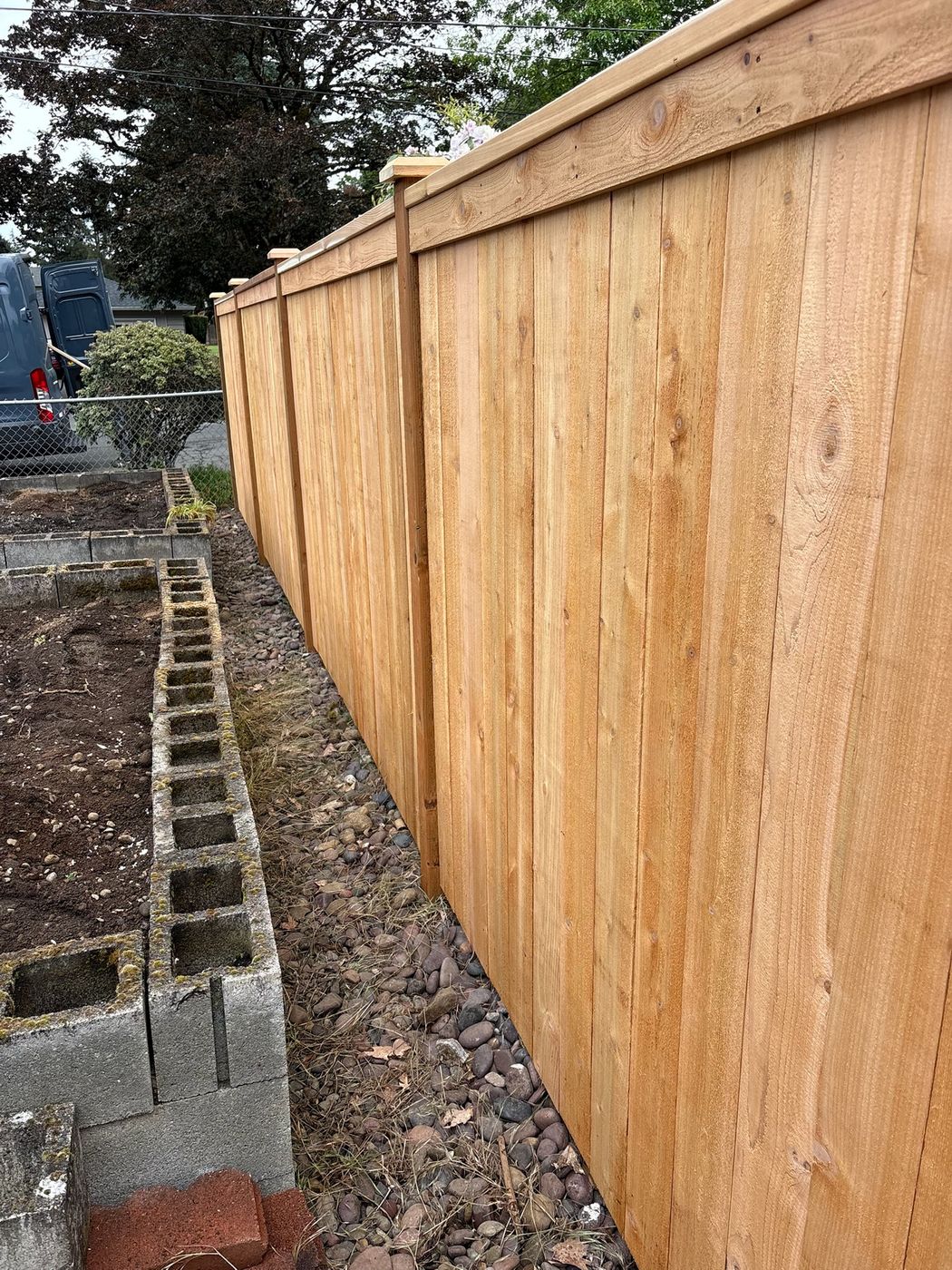
In most cases, yes: you can build a fence directly on your property line in both Oregon and Washington. Neither state requires you to set a fence back from the line. But "you can" and "you should just start digging" are two different things. Before the first post goes in the ground, you need to know your city's height and permit rules, plus the property line fence rules that decide who is responsible for it once it exists.
We field this exact question on a regular basis, usually from a homeowner who just found out an old fence is not quite where they thought it was. Here is the real breakdown for Portland, OR and Vancouver, WA.
Can You Build a Fence on Your Property Line?
Yes. Oregon and Washington both allow a fence built directly on the boundary between two lots. Neither state has a general law forcing a setback from the line itself. What changes by location is:
- Height limits and whether you need a permit (city and county rules, covered below)
- Who is responsible for the fence once it exists, if it ends up serving as a shared line between two properties (Oregon's "partition fence" law, covered below)
If you are only fencing your own yard and not touching a shared line, most of this is simple. It gets more important the moment the fence sits exactly on, or very near, the boundary.
How Close to the Property Line Can You Build in Portland?
For fences under the height that needs a permit (see the next section), Portland does not require a setback from the property line itself. Once a fence goes above 8 feet, it is treated more like a structure and has to meet your zone's regular building setbacks. Per the City of Portland's zoning code, those setbacks are:
| Zone | Front setback | Side / rear setback |
|---|---|---|
| RF, R20, R10 | 20 ft | 10 ft |
| R7 | 15 ft | 5 ft |
| R5, R2.5 | 10 ft | 5 ft |
Most residential fences (6-8 ft or under) never trigger this table. It matters mainly for tall privacy walls, sport-court enclosures, or anything over 8 feet.
Do You Need a Permit for a Fence in Portland?
Portland measures fence height from the ground at the base of the fence to the very top, and that includes any lattice, trellis, or decorative cap you add. Based on the City of Portland's own permit page:
- Wood or similar material: no permit needed up to 7 feet
- Masonry or concrete: no permit needed up to 4 feet
- Woven wire or chain link: no permit needed up to 8 feet
- Pool barriers/enclosures: always need a permit, regardless of height
Go taller than that, and you need a building permit. Anything over 8 feet also needs to be engineer-designed, no matter what it is made of. Zoning rules still apply even on a fence that does not need a permit, so if you are close to a corner lot or a busy setback zone, it is worth a quick call to Portland Permitting & Development (503-823-7300) before you build.
How Tall Can a Fence Be in Portland and Vancouver?
In Portland you can build a fence up to 8 feet tall in the side and rear building setbacks, but only 3 feet 6 inches in the front setback. In Vancouver WA the limits are 6 feet for a solid fence in the side, street side and rear setbacks, and 5 feet on the street side of your front wall, where the top foot has to be at least 80 percent open to views. Those are zoning height limits, and they apply whether or not your fence needs a permit.
That last point catches people out. Permit thresholds and height limits are two different rules. A 7 foot wood fence in Portland needs no building permit, but it still cannot sit in your front setback, because zoning caps that at 3 feet 6 inches. You have to clear both.
| Where on the lot | Portland, OR | Vancouver, WA |
|---|---|---|
| Front setback (street side of the house) | 3 ft 6 in in many zones | 5 ft, and the top 1 ft must be at least 80% open (wrought iron, chain link and similar) |
| Side and rear setbacks | Up to 8 ft | 6 ft for a solid fence |
| Outside the required setbacks | Over 8 ft allowed | Setback limits do not apply |
| Corner and driveway sight triangle | Zoning review, call PP&D | Under 30 in, or an 80% open fence kept clear of vegetation |
Portland measures height from the grade immediately under the fence, and anything you set on top counts. Posts, trellis, lattice and decorative caps are all part of the measured height, so a 6 foot fence with a foot of lattice on top is a 7 foot fence as far as the city is concerned.
This is why 6 feet has become the practical standard for a residential privacy fence across the metro. It clears Portland’s 8 foot side and rear limit with room to spare, it sits at Vancouver’s solid fence limit exactly, and in Portland it stays under the 7 foot mark where a wood fence would start needing a building permit. Go to 7 feet and you are still permit free in Portland but over the line in Vancouver. Go to 8 and you need a permit for wood on either side of the river.
What About Vancouver, WA and Clark County?
This is where a lot of homeowners get tripped up, because the rule is different depending on whether you are inside Vancouver city limits or in unincorporated Clark County.
| Location | Permit-free height | Notes |
|---|---|---|
| City of Portland, OR | Up to 7 ft (wood), 4 ft (masonry), 8 ft (chain link) | Setback table above kicks in over 8 ft |
| City of Vancouver, WA | Up to 6 ft | Cannot block access to a city water meter; setbacks reviewed case by case |
| Unincorporated Clark County, WA | Up to 7 ft | Fences 7 ft or under can be built up to the property line, even within an easement |
If your address is inside Vancouver city limits, the bar for needing a permit is one foot lower than the county's rule right next door. Either way, the fence still has to meet local zoning and cannot block access to utility equipment like a water meter. When you are not sure which jurisdiction your lot falls under, Clark County's or the City of Vancouver's planning desk can confirm it in a two-minute phone call.
Fence Rules in Camas, Washougal, Gresham and Happy Valley
Portland and Vancouver get all the attention, but most of the surrounding cities write their own fence rules, and several of them do not match what you will find repeated online. We read the adopted codes for the four we work in most. Three of them contain a rule that contradicts the common advice.
| City | Permit needed at | Front yard limit | Side and rear limit |
|---|---|---|---|
| Camas, WA | Over 7 ft | 42 inches | 6 ft |
| Washougal, WA | Over 6 ft | 48 inches | 6 ft |
| Gresham, OR | No permit for a residential fence | 4 ft forward of the front setback | 6 ft |
| Happy Valley, OR | 7 ft and taller | 4 ft | 8 ft |
Camas caps a front yard fence at 42 inches, not 4 feet
This is the one that catches people. Camas Municipal Code 18.17.050(C)(2) says a fence or wall shall not exceed forty-two inches high in the front yard. Almost every guide online rounds that up to 4 feet. Six inches does not sound like much until the fence is standing and the city asks you to cut it down.
Camas changed its permit trigger at the end of 2025
Camas now requires a building permit only when a fence or wall is over seven feet high, under CMC 18.17.050(B). That came in with Ordinance 25-025, adopted in December 2025. A lot of pages still quote the old rule of over six feet. There is a catch worth knowing though: CMC 18.17.050(C)(3) still says anything over six feet has to meet the required setbacks. So a 7 foot fence in Camas needs no permit, and still cannot sit on your property line.
Happy Valley lets you go to 8 feet in the back
Happy Valley is more generous than its neighbors. Land Development Code 16.44.055.A.1.a allows a fence up to eight feet where it sits behind the front of the building, or more than 30 feet back from the front property line, whichever is less. In front of that line the limit drops to four feet. A building permit kicks in at 7 feet and taller, and the city wants a site plan showing the house, the fence line, your property lines and the height.
A fence on a retaining wall is measured three different ways
If your yard is stepped, this decides whether your plan is legal. Happy Valley measures the fence on its own and ignores the wall under it, per LDC 16.44.055.A.2.c. Clark County measures the fence down to the grade at the bottom of the wall, per CCC 40.320.010(F)(4). Camas adds the two together and caps the total at 42 inches in a front yard or 6 feet in a side or rear yard, per CMC 18.17.060(D)(1). Same wall, same fence, three different legal heights depending on which side of the line you are on.
Two cities publish handouts that disagree with their own code
Washougal Municipal Code 18.46.110 allows 6 feet in the street side yard of a corner lot behind the front setback line, while the city fence handout treats both street frontages as front yard, which would mean 4 feet. Gresham has a similar gap: the handout says the 4 foot limit applies to the front 10 feet of the property, but code section 9.0410(A)(1) ties it to the minimum front yard setback, which is deeper than 10 feet in most Gresham zones. When a handout and the adopted code disagree, the code is the one that governs, and it is worth a phone call before you set posts.
Who to call
- Camas: Community Development, and the fence rules live in CMC Chapter 18.17
- Washougal: Community Development, Building, at (360) 835-8501
- Clark County: Permit Center at 564.397.4078
- Gresham: Planner on Duty at (503) 618-2780
- Happy Valley: Planning Division at (503) 783-3800
Codes get amended, and Camas is proof that a rule can change while the rest of the internet keeps quoting the old one. Everything above was read straight from the adopted code, but check the current version or make the call before you build.
Not sure if your project needs a permit?
Gorilla Works has been building fences in Portland and Vancouver for 20+ years, licensed and insured in both states. We will walk the line with you before anything is scheduled.
Licensed, bonded & insured in both states · 20+ years in the Portland area · Call (971) 343-4964
Who Owns a Fence Built Right on the Property Line? (Oregon's Partition Fence Law)
Oregon has a specific law for this, called the partition fence rule (ORS 96.010). If a fence sits on the boundary and effectively encloses land on both sides, both landowners are considered to benefit from it, and both are on the hook for their share.
In plain English: if you build a fence on the line and it also closes in your neighbor's yard, they legally owe you half the value of the portion that serves as their boundary too. That does not mean they get a vote on your fence style or your budget. It means the law treats a true boundary fence as a shared asset once it is standing.
What If My Neighbor Won't Pay Their Share or Won't Maintain the Fence?
Oregon has a process for this too (ORS 96.020 and ORS 96.030). If a neighbor refuses to maintain or repair their share of a partition fence, you can bring a complaint to a justice of the peace, who inspects the fence and can order the repair done within a set time. If they still do not act, you are allowed to make the repair yourself and recover the cost from them in court, and the prevailing party can recover attorney fees.
This is a real legal process, not just a suggestion. It rarely needs to go this far. Most disputes settle once both sides know the rule exists.
Not sure the fence is even yours to begin with? See our guide to who owns the fence and how to tell which side is yours.
What Happens If a Fence Was Built on the Wrong Side of the Line?
This comes up more than people expect, especially with older fences nobody has ever surveyed. Oregon law (ORS 96.060) covers a fence built by honest mistake on someone else's land: the person who built it gets one year from the date the mistake is discovered to go onto that land and remove the fence, without being considered a trespasser for doing so. During that year, the other landowner cannot tear the fence down or disturb it either. After that window closes, it gets more complicated and usually needs a real property line survey or a lawyer.
The easiest way to never need this statute: know exactly where your line is before you build.
How to Tell If a Fence Is Yours or Your Neighbor's
A few practical ways to check, in order of reliability:
- Pull your property survey or plat map. Your title company or the county assessor's office can usually provide a copy or point you to the recorded plat.
- Check the county assessor's online tax lot map. It shows approximate lot lines and is a good first check, though it is not survey-grade accurate.
- Do not rely on which side the "finished" face points. It is common practice for the smooth/finished side of a fence to face the neighbor's yard as a courtesy, but that is a custom, not a legal rule that proves ownership in Oregon or Washington.
- When money or a real dispute is involved, get a licensed surveyor. A stake in the ground from decades ago is not proof; a current survey is.
A Simple Property-Line Checklist Before You Build
- Get a copy of your plat or survey, even an old one is a starting point
- Have a conversation with your neighbor before the crew shows up, not after
- Confirm your city or county's permit-free height (see the tables above)
- Call 811 to have utility lines marked before any digging
- Decide up front who is paying if the new fence will sit on a shared line
- Put the agreement in writing, even a simple text or email works
How Gorilla Works Handles Property Lines and Permits
We build fences for a living in Portland and Vancouver, which means we deal with property lines on almost every job. Every Portland fence installation we take on starts with confirming where the line actually is, not guessing from an old post or a neighbor's memory. We are licensed, bonded, and insured in both states (Oregon CCB #198186, Washington L&I #EXTERDC884PP), so the permit and inspection side of a taller fence gets handled the right way instead of becoming your problem six months later.
Every install also comes with heavy-duty pressure-treated or lifetime steel posts, options like a shared good neighbor fence style that looks the same from both yards, and a 3-year workmanship warranty on cedar fences (lifetime on steel posts) if anything about the work itself needs fixing.
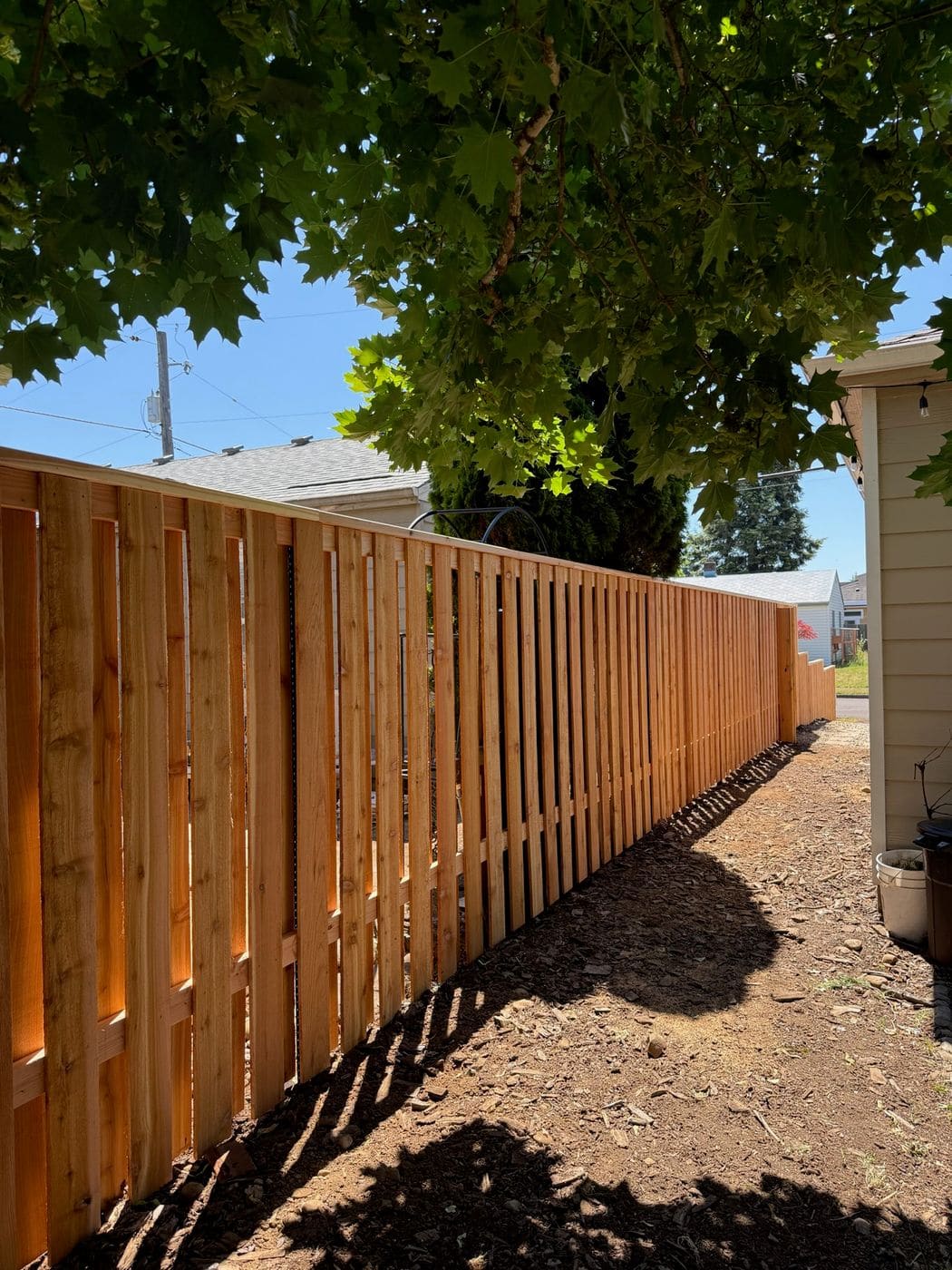
If you are not sure yet what material fits your yard, that is a normal starting question, not a delay.
Deciding between wood or chain link for a shared boundary line is another common one, and we walk through the trade-offs on both.
We also cover the layout side of things, like horizontal fence design options, once the line itself is confirmed.
Frequently Asked Questions
How tall can a backyard fence be in Portland?
Eight feet. Portland allows a fence up to 8 feet in the side and rear building setbacks, and taller than 8 feet outside those setbacks. A wood fence does not need a building permit until it passes 7 feet, so the common 6 foot cedar privacy fence sits comfortably inside both rules.
What is the standard fence height for a Portland or Vancouver home?
Six feet, for the reasons above: it is under Portland’s 8 foot side and rear limit, at Vancouver’s 6 foot solid fence limit, and under Portland’s 7 foot wood permit threshold. Front yards are the exception. Portland caps the front setback at 3 feet 6 inches and Vancouver at 5 feet with an open top foot.
Does lattice or a decorative cap count toward fence height?
Yes. Portland measures from the grade at the base of the fence to the very top, and posts, trellis, lattice and any other material placed on top are all counted as part of the fence. Add a foot of lattice to a 6 foot fence and the city reads it as a 7 foot fence.
Do I need my neighbor's permission to build a fence on my own side of the property line?
No. If the fence is entirely on your own property, you do not need their permission, though telling them ahead of time avoids most disputes. If you want to build directly on the shared line, it is worth talking first since Oregon's partition fence law can make them a co-owner of it.
Can I legally make my neighbor pay for half the fence?
Only if it qualifies as a true partition fence under Oregon law, meaning it sits on the line and encloses both properties. A fence built entirely inside your own yard does not trigger this.
Does the good side of the fence legally have to face my neighbor?
No. It is a common courtesy, not a law in Oregon or Washington. Some HOAs do require it in their own rules, so check your HOA agreement if you have one.
What is the very first thing I should do before building a fence near a property line?
Find your survey or plat map and confirm the line, then check your city or county's permit-free height limit. Both take less time than one wasted trip if an inspector flags the fence later.
Do these permit height rules apply if my fence is set back from the property line, not on it?
Yes. The height thresholds in Portland, Vancouver, and Clark County are based on the fence itself, not on how close it is to the line, unless you are over 8 feet, where zoning setbacks also come into play.
What if the fence I want to replace was already there when I bought the house and I don't know whose side it's on?
Treat it the same as a new build. Pull the survey, check the tax lot map, and if it really matters (for example, you are replacing it with something more expensive), get a current survey before you start.
Sources
- City of Portland, Fence Residential Building Permits
- City of Vancouver, WA, Fences, Decks, and Sheds
- Oregon Revised Statutes, Chapter 96, Line and Partition Fences
- City of Portland, Brochure 3: Fences, Decks and Outdoor Residential Projects
- City of Portland, Commonly Asked Zoning Questions
- Vancouver Municipal Code 20.912.050, Location and Height of Fences and Walls
- Camas Municipal Code Chapter 18.17 (fences, walls and vision clearance)
- Washougal Municipal Code 18.46.110: Fences and hedges
- City of Washougal: Fence Regulations
- Clark County Code 40.320.010: retaining walls and fences
- Clark County: Building permit FAQs
- Gresham Community Development Code Section 9.0400: Fencing
- City of Gresham: Residential Fences handout
- Happy Valley Land Development Code 16.44.055
- City of Happy Valley: Fences and Retaining Walls
Ready to build it right the first time?
Talk to the Gorilla Works team about your fence project in Portland or Vancouver, WA.
Licensed, bonded, and insured · Free quotes · Call (971) 343-4964
Gorilla Works proudly serves Portland, Gresham, Beaverton, Hillsboro, Tigard, Lake Oswego, Happy Valley, Milwaukie, Troutdale, Vancouver WA, and Camas WA. Call (971) 343-4964 or request fence installation.