If you are replacing windows in an older Portland home, the choice that matters most is not the brand on the sticker. It is how the window goes in: a full-frame tear-out or a pocket insert. For most homes around here the honest answer is full-frame, and our own job records back that up. About 8 out of 10 of the window jobs we run in the Portland and Vancouver area are full-frame tear-outs, not inserts.
A lot of companies will not tell you that, because the insert is the easier sale. Here is the real difference, a test you can do yourself, and how to know which one your house needs.
The two ways a window gets replaced
Pocket insert, also called a retrofit or insert replacement. The old sash comes out, the existing frame stays, and the new window drops into that old frame. It is faster, less invasive, and costs less to install. On a home where the original frame is still square, dry, and solid, it is a perfectly good option.
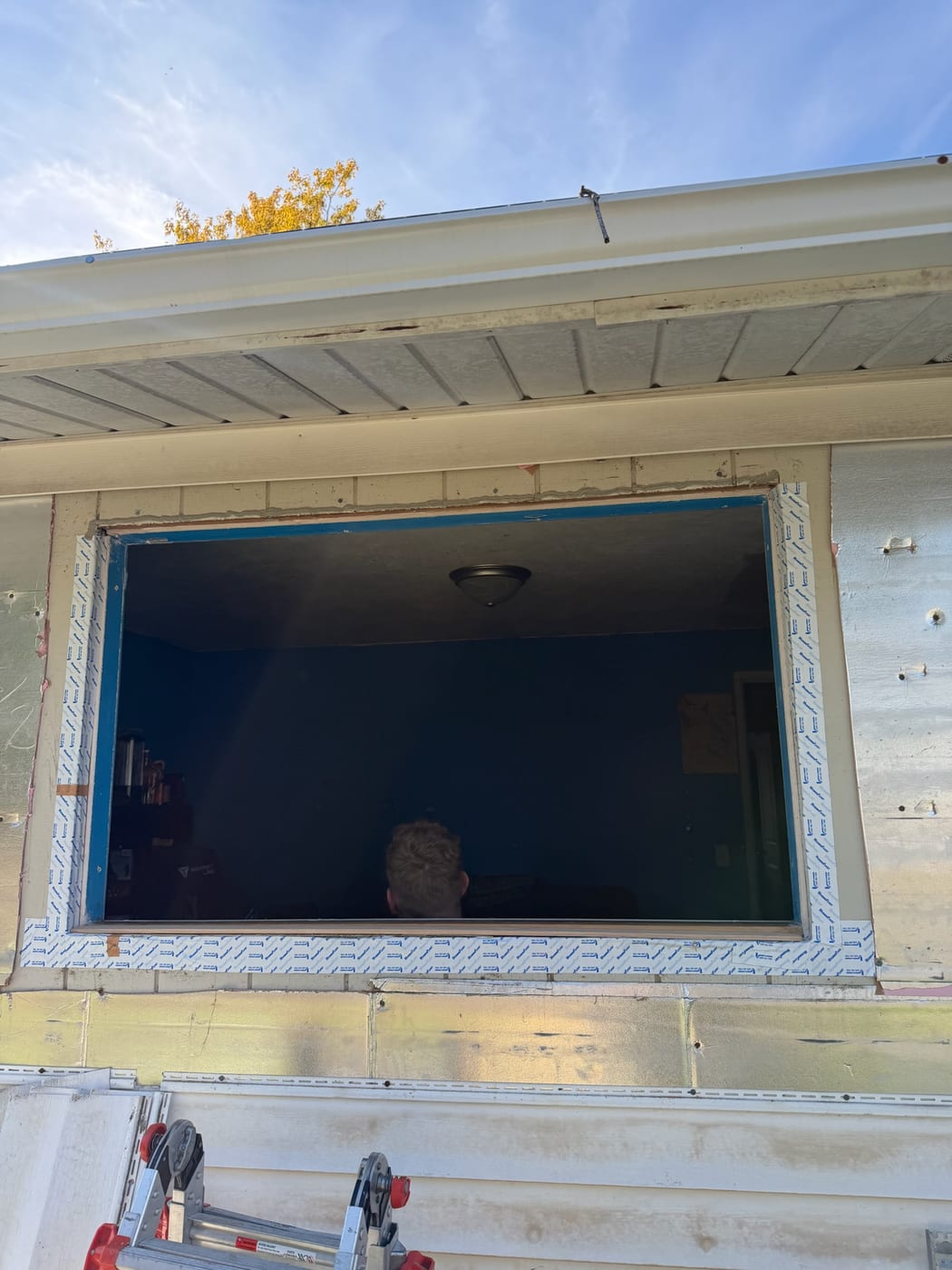
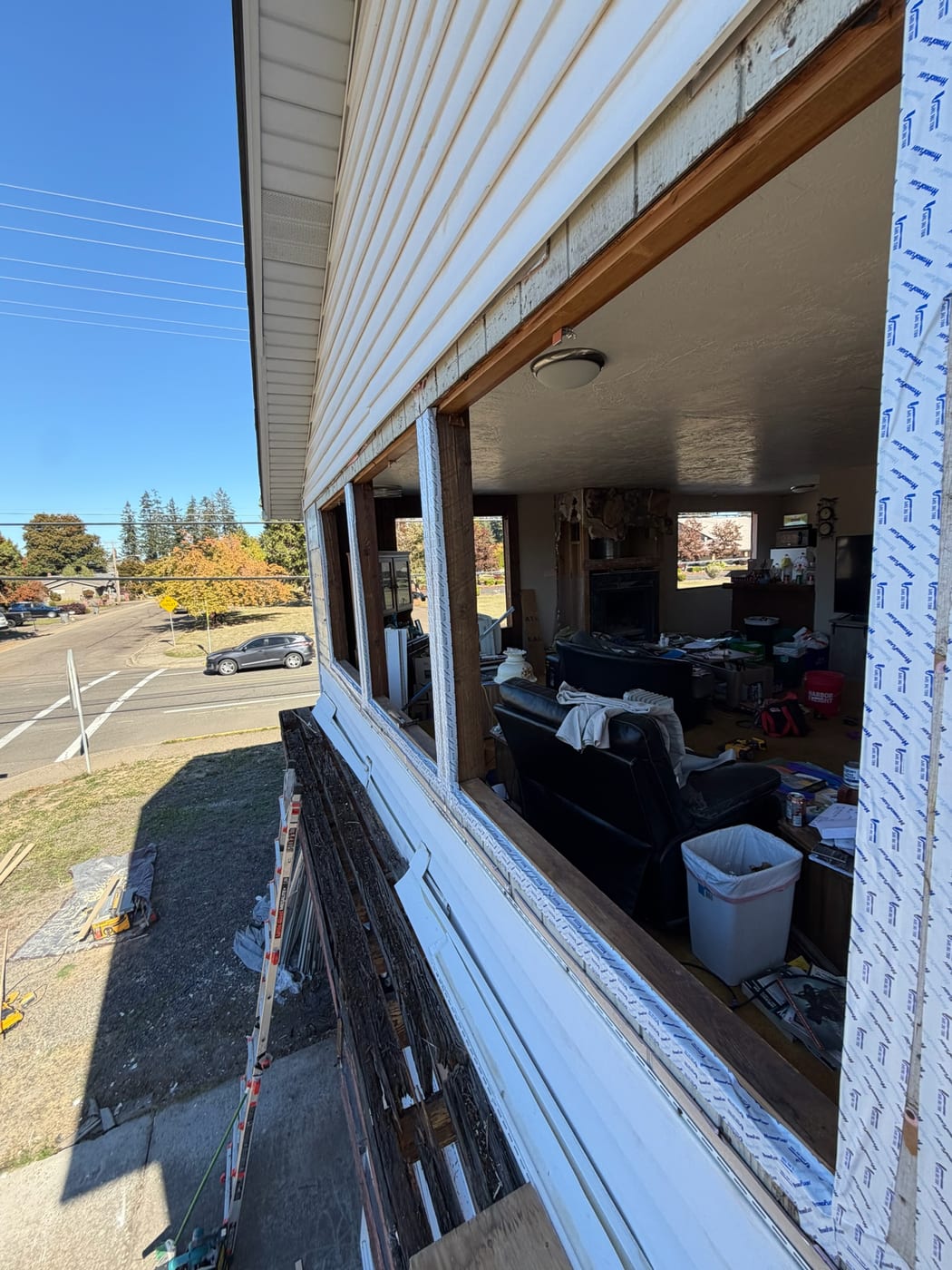
Full-frame replacement, a tear-out. The whole window comes out down to the rough opening, including the old frame and usually the exterior trim. The opening gets inspected, any damage gets fixed, new flashing goes in, and the new window is set and sealed from scratch. It is more work, but it is the only way to deal with what is often hiding behind the trim on an older house.
How to tell if your windows need a full-frame job
You can get a good read before anyone comes out. The rule the whole trade agrees on is simple: an insert only works in a frame that is sound, square, and dry. Here is how to check your own.
- The screwdriver test. Look at the bottom corners of the frame, where the sill meets the jambs. If the paint is bubbled, wavy, or cracked there, press a screwdriver or your thumb into the wood. If it gives, flakes, or sinks in soft, the frame is rotting, and an insert just buries the problem behind a shiny new window.
- Does the sash stick or sit crooked? A window that is hard to open, or where the gap along the sash is wider on one side than the other, usually means the frame has racked out of square. You cannot square it back up with an insert.
- Water stains, soft spots, or mold on or around the frame, inside or out. That is water that already got in.
- Old aluminum or thin old vinyl frames are often too weak or warped to hold an insert well in the first place.
If you see any of those, plan on a full-frame job. If the frame is clean, square, and solid, an insert may be all you need.
Not sure what your frames need?
We will pull a corner of trim, look at the real condition, and tell you straight whether it is a full-frame job or an insert. Free, no pressure.
Licensed, bonded & insured · Milgard-certified · 20+ years in the Portland area · Flexible financing
Why so many Portland homes need full-frame
Portland and the rest of the Willamette Valley are full of older houses. More than 60 percent of the homes in Multnomah County were built before 1980, and almost a quarter were built before 1940. The homes we actually replace windows in run the same way: our recent jobs were in houses built anywhere from 1942 to 2002, with the middle sitting around 1981.
Here is the part the brochures skip. Water intrusion is the number one cause of building envelope failure, and most of it traces back to bad or missing flashing around the windows, not to the windows themselves, which is why the industry has a written install standard, ASTM E2112. In our climate that matters more than almost anywhere. We get rain more than 150 days a year, around 36 inches downtown and over 44 inches a year out by the airport, and it is that steady frequency that finds every weak seam.
So on an older home, a lot of what is wrong is not the window at all. It is a failed or missing flashing detail that has been letting water into the wall for years, quietly rotting the sill and framing where you cannot see it. A pocket insert does nothing about that. It leaves the bad flashing in the wall and sets a new window right on top of it. A full-frame tear-out is the only version that lets us find the water source, fix the rot, and re-flash the opening so it actually stays dry.
Full frame vs insert, side by side
| Pocket insert | Full-frame tear-out | |
|---|---|---|
| What stays | The old frame and old flashing | Nothing, down to the rough opening |
| Install time | Shorter | Longer |
| Glass area | Slightly smaller, sits inside the old frame | Keeps the full opening |
| Finds hidden rot or damage | No | Yes |
| New flashing and full re-seal | No | Yes |
| Best when | The frame is square, dry, and solid | The frame is old, out of square, or water has been getting in |
| How often we do it here | Roughly 2 in 10 jobs | Roughly 8 in 10 jobs |
The install is where the job is won or lost
A new window is only as good as the flashing behind it. This is the part a cheap or rushed crew skips, and it is where most leaks start. The correct way to set a window, spelled out in the industry standard ASTM E2112 and by the Department of Energy, goes like this.
- A sloped sill so water drains out, not in.
- A sill pan with a back dam under the window, so any water that gets in is caught and sent back outside instead of into your wall.
- Jamb flashing that laps over the sill pan, then head flashing on last, over the jambs, so every layer sheds water onto the one below it, like shingles.
- Low-expansion foam around the frame. Regular expanding foam bows the jambs and can make the window bind.
The single most damaging mistake is reverse-lapping the flashing, for example tucking the head flashing under the jambs, which funnels water behind the flashing instead of over it. The other classic is using a bead of caulk as if it were flashing. Caulk is not flashing. It dries out and cracks, and then the wall is open again. When you are comparing window quotes, ask how they flash the opening. If the answer is that they caulk it, keep looking.
When an insert is actually the right call
Full-frame is not automatic. We will recommend a pocket insert when the existing frame is genuinely in good shape, usually on a newer home or one where the windows were already replaced correctly once before. If the frame is square, dry, and solid, an insert saves you time and money, and there is no reason to tear out good material. The point is not that full-frame is always better. The point is that someone has to actually open it up and look, instead of selling you the quick version sight unseen.
What we install here
For almost all of our window work we install Milgard vinyl windows, mostly the V250 and the V300 Trinsic series, set with new flashing on a full-frame job. We work across the whole metro, and new windows in Oregon have to meet a U-factor of 0.27 or better under the current state energy code, which we spec the glass to pass on every Portland window installation.
Questions we get about full frame vs insert
Is a pocket insert cheaper than full-frame?
Yes, the install is less work so it costs less. But on an older home an insert can trap a problem you will pay for later. The cheaper install is not the cheaper outcome if there is rot or bad flashing behind the trim.
Will I lose glass with an insert?
A little. An insert sits inside the old frame, so the visible glass gets slightly smaller. A full-frame replacement keeps the full size of the opening.
How do I know if my frame is good enough for an insert?
Do the screwdriver test on the bottom corners and check that the sash is square and opens easily. If the wood is soft or the frame is racked, it is a full-frame job. When in doubt, the real answer comes once the trim is off.
Do you have to replace the trim on a full-frame job?
Usually yes. On a tear-out the exterior trim comes off so we can inspect and re-flash the opening, so it gets replaced as part of the job.
Does new flashing really matter that much?
It is the whole game in a wet climate. Water intrusion, almost always a flashing problem, is the leading cause of wall damage around windows. A great window with bad flashing still leaks.
If your current windows are fogging up or past their lifespan, that is usually a sign it is time to plan a replacement.
Thinking about new windows on an older Portland home?
We will come out, look at what you actually have, and tell you straight whether your frames need a full-frame tear-out or whether an insert will do the job. No pressure, just an honest read from someone who has been opening up Portland walls for 20 years.
Call or text (971) 343-4964, or request a free quote on our window installation page.
Sources
- U.S. Census Bureau, American Community Survey 2019-2023, Table B25034: year structure built, Multnomah County, OR
- NOAA National Weather Service, Portland OR climate normals (annual precipitation and rain days)
- U.S. Department of Energy: proper window installation, flashing and sill pan guidance
- ASTM E2112: Standard Practice for Installation of Exterior Windows, Doors and Skylights
Gorilla Works proudly serves Portland, Gresham, Beaverton, Hillsboro, Tigard, Lake Oswego, Happy Valley, Milwaukie, Troutdale, Vancouver WA, and Camas WA. Call (971) 343-4964 or request window installation.