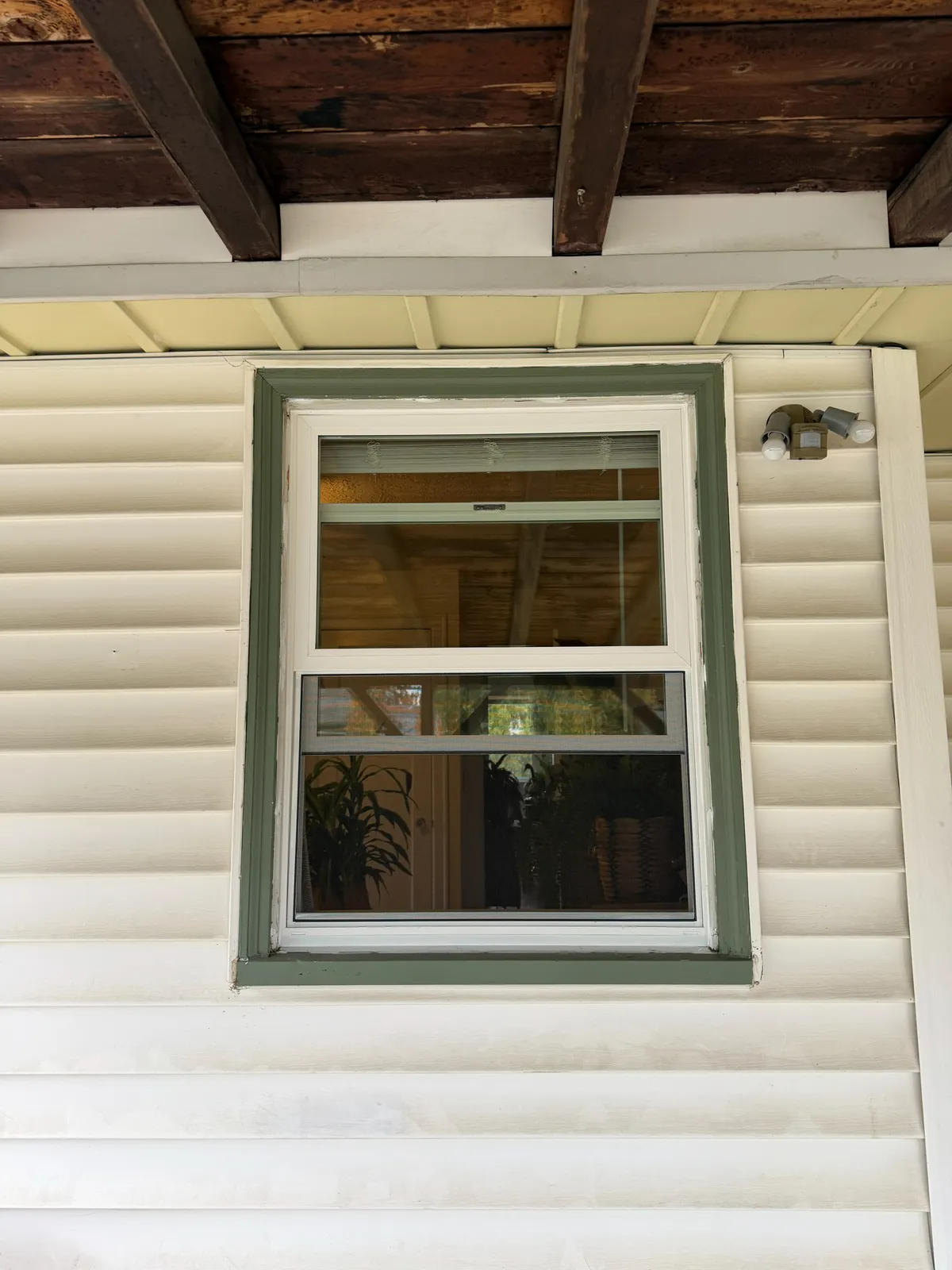
If you own a manufactured or mobile home in the Portland and Vancouver area and your windows are fogged, drafty or single pane, here is the short answer. Yes, the windows can be replaced. In Washington, swapping a window into the same opening with no structural change needs no permit. In Oregon the state rule does not say either way, so check with your city or county first. Bedroom windows in both states have to stay big enough to climb out of, and the federal HUD code sets that size.
We wrote this after a homeowner with a 1976 manufactured home on the Oregon coast asked us two questions: can you replace my windows, and can I make monthly payments? The answer to both was yes. Finding the real rules behind that answer took digging, because most of what ranks for this search is a parts store selling one-size windows. Everything below comes from the federal code, Oregon and Washington rules, and the utilities, with links at the end.
Thinking about new windows for a manufactured home?
We measure every opening at your home, check which windows are bedrooms, and give you one written price that names the exact window for each opening. Monthly payment plans are available for qualified buyers.
OR CCB 198186 · WA L&I EXTERDC884PP · Family business since 2002
First, find out if your home is a HUD-code home
The federal Manufactured Home Construction and Safety Standards, which everyone calls the HUD code, apply to homes built on or after June 15, 1976. The date that counts is when the home entered its first stage of production, not when it was sold. So a home people call a 1976 can land on either side of the line. That is exactly the case we were asked about.
Look for the red HUD label on the outside of each section and the data plate inside, often in a bedroom closet or by the electrical panel. A home with the label was built to the HUD code, and new windows should keep it in line with that code. Oregon allows homes built before June 1976 to follow the older 1972 ANSI A119.1 mobile home standard for alterations. Take a photo of the label and the data plate before anyone measures. It answers half the questions on the first visit.
Do you need a permit to replace windows in a manufactured home?
This is where Oregon and Washington are different, and almost nobody explains it.
| Situation | Washington (L&I, WAC 296-150M-0302) | Oregon (OAR 918-500-0580 and your city) |
|---|---|---|
| New window in the same opening, no structural change | No permit or inspection | Not listed as exempt. Ask your city or county building office before work starts |
| Making an opening bigger or cutting a new header | Permit and inspection required | Permit required. Portland says changes that add loads, such as cutting a header, also need engineering |
| Replacing only the glass | No permit | Not addressed. Ask locally |
| Bedroom windows | Must be an egress type | Must keep meeting the code the home was built to |
| Who pulls the permit | The contractor doing the work, before the work starts | The state before the first sale, your city or county after it |
Washington is the clear one. The Department of Labor and Industries publishes a table of manufactured home alterations, and a window replaced in the same opening with no structural changes is marked no permit, no inspection. The footnote adds that bedroom windows must be the egress type. If the opening has to change, a permit is required, and the contractor buys it before the work.
Oregon is vaguer. The state rule for alterations to manufactured dwellings lists what is exempt from permits, and windows are not named. The City of Portland says alterations to manufactured dwellings need a permit and plans, and that anything adding weight or side loads, like cutting a header, needs engineering. The honest advice: a same-size swap is the simplest job, a resized opening is a permit job, and a five-minute call to your building office settles it before anyone orders windows.
The bedroom window rule is stricter than you might think
Every room built for sleeping needs at least one window you can escape through, unless it has an outside door. In a manufactured home the HUD code sets the size. A site-built Oregon house follows the residential code instead, and the two are not the same.
| Bedroom escape window | Manufactured home (HUD 3280.404 and 3280.106) | Site-built house in Oregon (residential code, R310 in the 2023 edition) |
|---|---|---|
| Clear opening | At least 5 sq ft | At least 5.7 sq ft |
| Clear width | At least 20 in | At least 20 in |
| Clear height | At least 24 in | At least 24 in |
| Highest sill from the floor | 36 in | 44 in |
| Other rules | No sash removal to reach the size, locks no higher than 54 in, no rolled-in screens unless hinged | Opens normally from inside |
Two things follow from that table. First, you usually cannot shrink a bedroom window to make it easier to fit, a shortcut the parts stores suggest for other rooms. Second, the style matters. A slider only opens half its width, so a bedroom slider has to be wide enough that the open half still clears 20 inches wide and 5 square feet. A casement swings fully open and clears the size in a smaller frame. Every HUD egress window also needs its operating label left on.
Which windows need safety glass
The HUD code requires tempered or other safety glass in spots where people can fall into a pane. If you are replacing any of these, the new glass has to be safety rated:
- Windows less than 60 inches above the floor that enclose or sit beside a tub or shower.
- Glass within 12 inches of a door edge and less than 60 inches above the floor.
- Big low panes: more than 9 sq ft, bottom edge under 19 inches, top edge over 36 inches, within 36 inches of a walking surface.
- Glass in entry doors and sliding patio door panels.
You live in the coldest HUD zone
HUD splits the country into three thermal zones for manufactured homes. Oregon and Washington are both Zone 3, the strictest one, and the code requires Zone 3 homes to leave the factory with storm windows or insulating glass. HUD did not add its energy standards until 1995. That is why homes from the 1970s and 1980s around here so often still have single pane aluminum windows that sweat all winter. Energy Trust of Oregon says older manufactured homes, especially those built before 1995, have the least efficient windows, insulation and heat.
For a frame of reference, the energy codes for houses in Oregon and Washington cap new windows at a U-factor of 0.27 to 0.30, depending on the state and the job. A single pane aluminum window loses heat far faster than that, so the change in comfort near a window is the first thing most people notice.
Why a window from the store usually does not fit
Manufactured home windows are a different animal from house windows. Walls are often 2x3 or 2x4 instead of the deeper walls in most houses, and sizes are not standard. Many older units use a flush-mount window that screws on over the siding, while others are tucked under lap siding. The parts stores say it themselves: measure the rough opening and note the wall thickness, because a standard window off the shelf rarely drops in.
Three things decide what goes in your openings:
- Wall depth. A thin wall leaves less room for the window frame to sit, which rules some frame types in or out.
- What is around the opening. A block-frame replacement window needs a solid wood frame left in place, and Milgard says that frame must be in good condition. Many manufactured home openings do not have one.
- Whether the siding is coming off. A nail-fin window nails to the framing and gets flashed behind the siding, which is the strongest seal against rain, but only practical when the siding is being replaced anyway.
This is where a custom window helps. Milgard builds every window to the size measured at the home, so we are not forcing a stock size into an odd opening. We install the Milgard V250 Style Line, V300 Trinsic and V400 Tuscany vinyl series and the C700 fiberglass series. To be clear, Milgard does not advertise a window made for manufactured homes. Whether one of its windows is the right fit for your home depends on the three checks above, and we tell you on the first visit.
If your siding is tired too, doing both at once is the best case for the windows, because the new ones can be flashed into the wall the right way. See our siding installation page for what that job looks like.
Get a written price for every opening
We check wall depth, bedroom egress and the siding detail, then give you one written price with tear-out and haul-away of the old windows listed. Payment plans with zero down are available for qualified buyers. All financing is subject to credit approval. Rates, terms and payments may vary based on credit.
OR CCB 198186 · WA L&I EXTERDC884PP · Family business since 2002
Rebates for manufactured home windows in 2026: what is real
Many pages still list programs that have closed. Here is what we found on the program pages themselves, checked November 11, 2026:
| Program | Who it is for | Status |
|---|---|---|
| Energy Trust of Oregon, residential windows | SW Washington homes heated by NW Natural gas, manufactured homes included. Replaces single pane or metal double pane with windows rated U-0.30 or better | Open. Oregon homes are not listed on this page |
| Clark Public Utilities weatherization | Clark County homes and manufactured homes with electric heat, through its contractor network | Open. Tiers by window rating |
| Energy Trust, manufactured home replacement | Oregon and SW Washington homes built before 1995, income guidelines | Open, but it helps replace the whole home, not the windows |
| Oregon state home energy rebates | Oregon homeowners | Not launched yet |
| Oregon OHCS manufactured home replacement program | Oregon | Closed to applications since Nov 1, 2025 |
| Federal window tax credit (25C) | US | Ended for windows installed after Dec 31, 2025 |
Rules change, so check the program page before you count on any of it. For the rest of the Portland and Vancouver picture, including site-built homes, see our window rebates guide for Portland and Vancouver.
What to have ready before you call anyone
- A photo of the HUD label and the data plate, plus the year the home was built.
- Which windows are in bedrooms, and which are by a tub, shower or door.
- How the windows attach: screwed over the siding, or tucked under it.
- Your heating type and utility. In SW Washington that decides which rebate you can use.
- Whether you are thinking about new siding in the next few years.
Payments are a normal part of these jobs. Through Service Finance we offer plans for qualified buyers, including Plan 2012 with no interest if paid in full in 12 months. The details are on our financing page.
Frequently Asked Questions
Can I use regular house windows in a manufactured home?
Sometimes. The HUD code accepts windows tested to the same North American window standard that house windows are rated to, so a quality custom window is not ruled out. Fit is the real question: wall depth, the frame around the opening, and bedroom egress size decide it.
Will new windows change my manufactured home insurance or resale?
Ask your insurer, since policies differ. For resale, keep the receipts, the window labels and any permit card. Buyers and lenders on manufactured homes look for proof that alterations kept the home in line with the HUD code it was built to.
Is a 1975 mobile home treated differently from a 1977 manufactured home?
Yes. A home that entered production before June 15, 1976 is not a HUD-code home. In Oregon, alterations to those homes can follow the 1972 ANSI A119.1 mobile home standard. Homes after that date follow the HUD code, including its egress and safety glass rules.
Can I make a small bedroom window bigger while I am at it?
Often, and it can be a good idea if the old one is below today's escape size. It is a structural change, though, so it needs a permit in Washington and a permit and possibly engineering in Portland. Plan it before the windows are ordered, since they are built to size.
Do new windows come with a warranty on a manufactured home?
The window maker covers the window and we cover the install. Window installs from Gorilla Works carry up to a limited lifetime workmanship warranty on the installation, with jobs not marked Limited Lifetime covered for 5 years. See our warranty page for the terms.
Ready to see what your openings need? Start with our window replacement in Portland and Vancouver page, or call and we will set up a visit.
Sources
- eCFR, 24 CFR 3280.106 Exit facilities; egress windows
- eCFR, 24 CFR 3280.113 Glass and glazed openings
- eCFR, 24 CFR 3280.403 Windows, sliding glass doors and skylights
- eCFR, 24 CFR 3280.404 Egress windows and devices
- eCFR, 24 CFR 3280.506 Heat loss, thermal zones (Oregon and Washington = Zone 3)
- eCFR, 24 CFR Part 3282 (June 15, 1976 start of production)
- HUD, Manufactured Home Resources
- Oregon Secretary of State, OAR 918-500-0580 Alterations to manufactured dwellings
- City of Portland, Manufactured home permits
- Washington Legislature, WAC 296-150M-0300 and 296-150M-0302 (alteration permit table)
- Energy Trust of Oregon, Residential windows incentive
- Energy Trust of Oregon, Manufactured homes
- Clark Public Utilities, Weatherization program
- Oregon Department of Energy, Home Energy Rebates
- Oregon Housing and Community Services, Manufactured Home Replacement Program
- IRS, Energy Efficient Home Improvement Credit
- Milgard, Window frames: your complete guide (block frame, flush fin)
- Milgard, Replacement vs new construction windows
- Foremost Insurance, Replacing mobile home windows
- Mobile Home Parts Store, Mobile home windows (measuring and wall thickness)
Gorilla Works proudly serves Portland, Gresham, Beaverton, Hillsboro, Tigard, Lake Oswego, Happy Valley, Milwaukie, Troutdale, Vancouver WA, and Camas WA. Call (971) 343-4964 or request window installation.