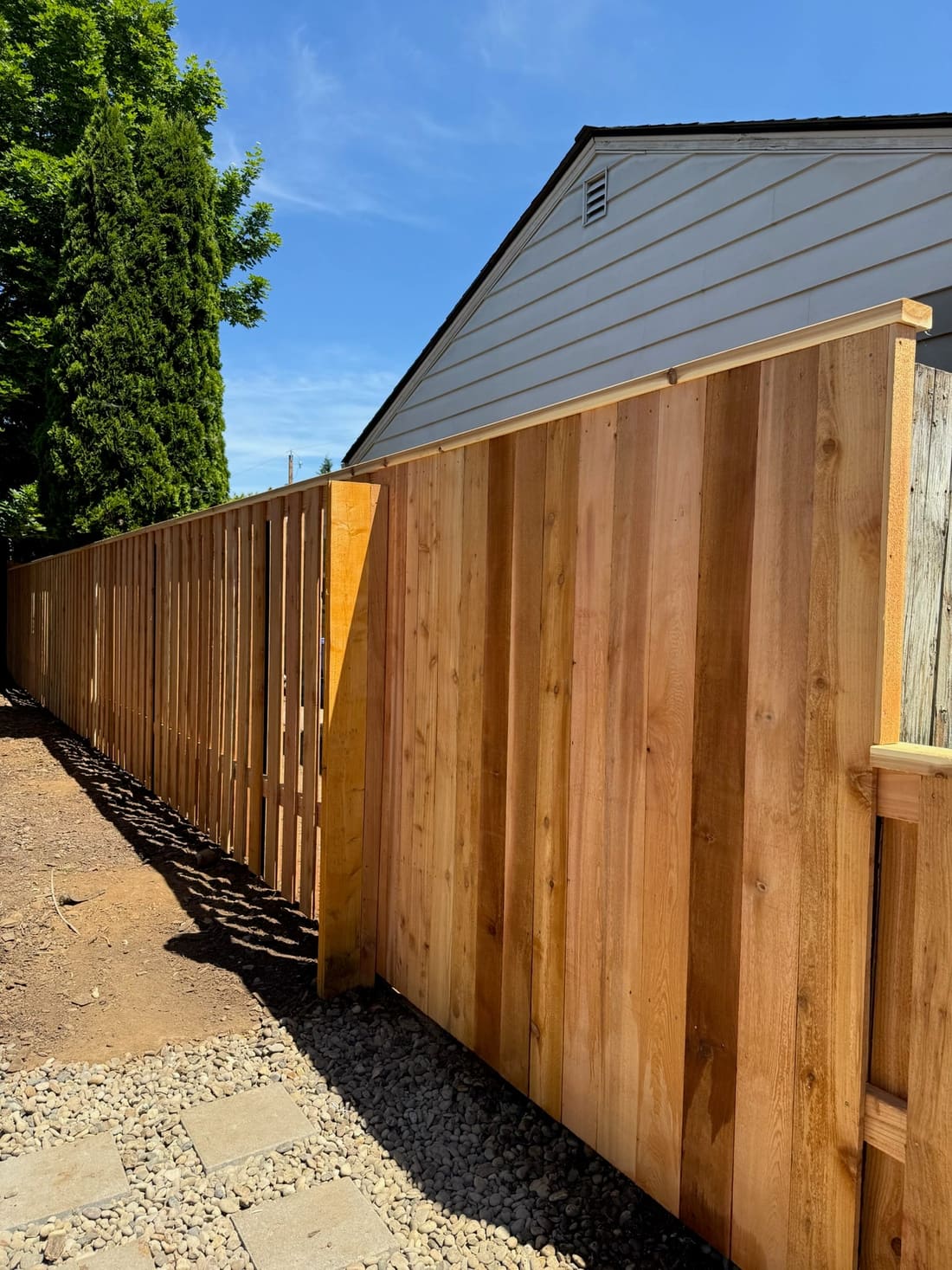
Privacy fence cost per foot is a useful way to compare quotes, but it is not a single number, and any crew that gives you one before seeing the yard is guessing. The per-foot price is set by a short list of real things: how tall the fence is, the grade of cedar, the fence style, the kind of posts, and how long and how flat the run is. Get those straight and the per-foot number stops being a mystery.
This is the per-foot deep dive. For the wider picture across every fence type, cedar and chain link and steel, start with our Portland fence cost guide. Below is what specifically moves the number when the fence is a privacy fence, written by a crew that builds them across the Portland metro and Southwest Washington every week.
Why Privacy Fence Cost Is Measured Per Foot
A fence is priced by the linear foot because that is the unit that scales: a longer fence uses proportionally more boards, posts, and labor. Per foot lets you compare one quote against another on the same basis. The catch is that the per-foot figure itself swings a lot depending on the choices below, so two honest quotes can both be fair and still land far apart.
The Things That Move the Per-Foot Price
The short answer: a privacy fence's per-foot cost is set by its height, the cedar grade, the fence style, the post type, and the length and slope of the run. Every other line on a quote is a version of one of those. Once you can see them, you can read any per-foot number and know exactly why it is high or low.
- Height. A privacy fence is usually six feet. Going taller adds material to every foot and can trigger a permit.
- Cedar grade. Builder-grade and premium cedar are not the same board and do not last the same, and this is the single biggest swing on most quotes.
- Fence style. A standard vertical fence, a good neighbor fence, and a board-on-board fence use different amounts of lumber for the same run.
- Posts. Pressure-treated wood posts are the baseline; a steel-post upgrade costs more per foot but ends wood rot at the post.
- The run itself. A long, straight, flat run is the lowest per-foot cost. Short runs, corners, slope, and gates all raise it.
Height: Why Six Feet Is the Privacy Baseline
Six feet is the standard privacy height across most of Portland and Vancouver, tall enough to screen a yard without special approval in most residential cases. Going above six feet adds boards, longer posts, and often a permit, so it raises the per-foot cost on two fronts at once. Height and where a fence can sit on the line are their own subject, and we cover the rules on our fence property line page.
If you are still working out where the fence can go and how tall it can be, our guide to fence height and property lines walks through the Oregon and Washington rules before you price anything.
Cedar Grade: The Biggest Swing on the Quote
The grade of the cedar is usually the line that moves a privacy fence quote the most, and it is the one most likely to be quietly downgraded to hit a lower per-foot number. Cedar is sorted by grade, and the grade decides how many knots the board has, how straight it stays, and how well it holds up in a wet climate.
| Cedar grade | What you get | Where it fits |
|---|---|---|
| Builder grade | More knots, warps and cracks more, shorter life in wet weather | The cheap way to a low per-foot number |
| Grade 1 premium | Minimal knots, stays straighter, resists warping and cracking | What we put on every install, at no upcharge |
| Clear cedar | Fewest knots, cleanest uniform grain, ages most evenly, longest life | The top-tier upgrade for the best face and lifespan |
This is where two per-foot quotes can look identical on paper and be very different fences. We use Grade 1 or better cedar on every install as our standard, not as an upsell, because builder-grade boards are what warp and gray and start needing repairs in a few Northwest winters. We also use stainless steel nails and fasteners on every cedar fence, so the fence does not get rust stains running down the boards a year later. Neither is an extra line on the quote.
Fence Style Changes the Board Count
The style you pick changes how much lumber a foot of fence uses, and that flows straight into the per-foot price.
- A standard vertical fence sets the boards edge to edge in one layer. It is the baseline per-foot cost.
- A good neighbor, or shadow-box, fence alternates boards on each side of the rail so it looks finished from both sides. It uses more lumber than a standard fence.
- A board-on-board fence overlaps the boards so there are no gaps even after the cedar dries and shrinks. It uses roughly twice the boards of a standard fence, which is why it is more per foot, and why it stays fully private for the life of the fence.
The style decision is worth making before you compare per-foot numbers, because a cheap quote may simply be a thinner fence. We break the styles down in our guides to the board on board fence and how a good neighbor fence differs from it.
Posts: Pressure-Treated or a Steel Upgrade
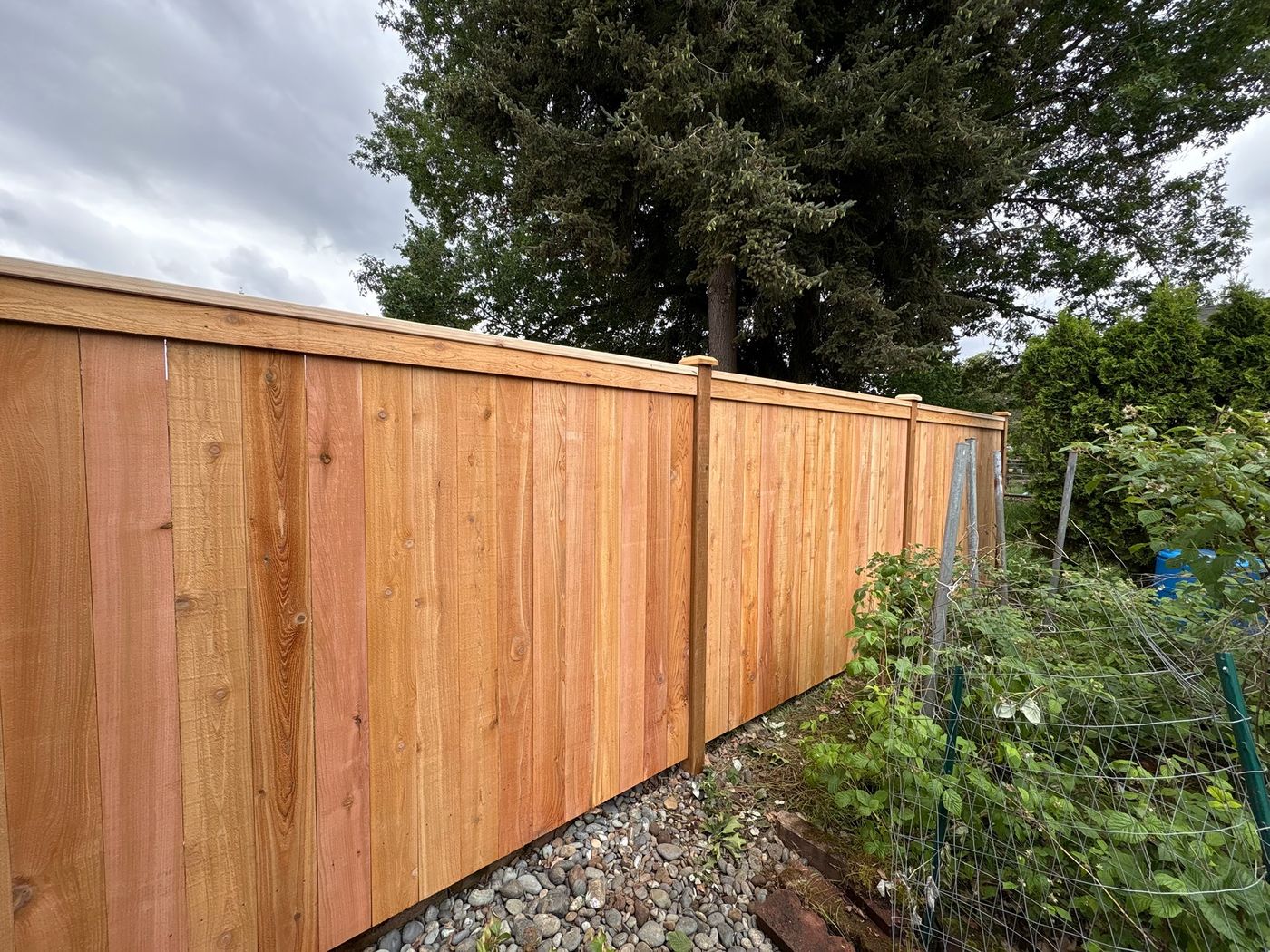
Posts are what a fence lives or dies on in this climate, because the post sitting in wet ground is the first thing to rot. Pressure-treated wood posts are the baseline and do the job well when set deep. A galvanized steel post is an upgrade that costs more per foot but never rots, and it can be hidden inside matching wood so the fence still reads as a true wood fence from both sides. On our top package the steel posts carry a lifetime post warranty.
How We Build a Privacy Fence
Our privacy fences are Grade 1 or better cedar, fastened with stainless steel, on pressure-treated or optional steel posts set deep for the wet Northwest ground. Cedar installs carry a three-year workmanship warranty, our premium builds carry five years, steel posts carry a lifetime warranty, and every fence includes a year of free gate adjustment. Every installer on the crew has at least five years of fencing experience, because a privacy fence built straight and set deep is what separates a fence that lasts from one that leans in two winters.
If you want the full range of what we build and how we work, our Portland fence contractors page lays out the materials, the styles, and how to get a written estimate for your own yard.
Want a real per-foot number for your yard?
We will walk your property, measure the run, talk through cedar grade, style, and posts in plain language, and give you a written quote with no pressure.
Licensed and insured. CCB #198186 in Oregon, L&I #EXTERDC884PP in Washington.
Frequently Asked Questions
What is a fair way to compare privacy fence quotes per foot?
Compare the same fence, not just the same number. Ask each quote for the cedar grade, the fence style, the post type, and the fastener. A lower per-foot price is often builder-grade cedar, a thinner style, or standard posts, which is a different and shorter-lived fence, not a better deal.
Does a taller fence cost more per foot?
Yes. A taller fence uses more boards per foot and longer posts, and above six feet it often needs a permit, so the per-foot cost rises on both material and process. Six feet is the usual privacy height that avoids that in most residential cases here.
Why is a board-on-board fence more per foot?
Because it uses roughly twice the boards of a standard fence, overlapping them so there are no gaps even after the cedar dries and shrinks. You are paying for more lumber and for a fence that stays fully private for its whole life instead of opening gaps.
Do I need a permit for a six-foot privacy fence?
In most residential cases in the Portland and Vancouver area a standard six-foot fence does not, while taller fences often do, and where the fence sits on the property line has its own rules. Our fence property line guide covers the Oregon and Washington specifics before you build.
Do you serve my area?
We build fences across the Portland metro and Southwest Washington, including Portland, Gresham, Beaverton, Hillsboro, Tigard, Lake Oswego, Happy Valley, Milwaukie, and Troutdale in Oregon, and Vancouver and Camas in Washington.
Sources
Gorilla Works proudly serves Portland, Gresham, Beaverton, Hillsboro, Tigard, Lake Oswego, Happy Valley, Milwaukie, Troutdale, Vancouver WA, and Camas WA. Call (971) 343-4964 or request a fence estimate.