
Board on Board Fence Installation in Portland, OR
A board on board fence is built in two layers. A first layer of pickets goes up with a deliberate gap between the boards, then a second layer covers those gaps, so nothing shows through anywhere along the run. It is the most private wood fence we build, and it stays that way as the cedar dries and moves through its first Portland summers.
- Grade 1 or better cedar, standard on every install
- Stainless steel fasteners, no rust streaking
- Limited 3-year workmanship warranty



Grade 1 Cedar, No Upcharge
Every cedar fence we build starts at Grade 1 or better, at no upcharge.

Stainless Fasteners
Stainless steel fasteners on every cedar fence, so rust never streaks down the boards.

Experienced Crew Leads
Every install crew is led by an installer with 5+ years of experience.
93 Google reviews, licensed & insured
What Is a Board on Board Fence?
A board on board fence is built in two layers. The first layer of pickets goes up with a deliberate gap between each board, roughly an inch and a half. The second layer then covers those gaps, each board lapping over the edges of the two behind it. Some builders call the same thing a board and batten fence.
That second layer is the whole point. On a standard privacy fence the boards sit edge to edge on installation day, and as cedar dries it shrinks across its width, which opens narrow gaps you can see straight through. Board on board builds the allowance in from the start, so the boards can move and the screen stays solid.
It uses more cedar per foot than a standard fence, because you are deliberately covering ground twice. That is the trade you are making: more material for a fence that does not develop see-through gaps in its second summer.
The look is heavier and more dimensional than a flat fence. The overlapping boards throw a shadow line down the run, which is why it reads as a more finished, more built fence from the street.
Not sure this is the style you want? Compare it against every style we install in our fence styles guide, see all five cedar styles on our cedar fence installation page, or see the full fence installation page.
Board on Board vs Good Neighbor
These two get confused constantly, including by people quoting them. The difference is one thing, and it decides both how private your yard is and whose side looks finished.
A good neighbor fence alternates its boards to opposite sides of the rails, so the fence looks the same from both yards. Because the boards alternate, a narrow gap sits between each pair. Straight on it reads solid, but walk along it at an angle and you catch slivers of sightline.
A board on board fence builds up in two layers on one side instead, a gapped base layer with a second layer covering the gaps. Nothing shows through from any angle, but you are back to a fence with a front and a back, which means deciding who gets the good side. Neither is better as a rule. They answer different questions, and we build both.
If matching both sides matters more than total privacy, read our good neighbor fence guide. If the fence runs along a shared line, it is also worth knowing what Portland and Vancouver allow on a property line before anything gets built.
| Features | Board on Board | Good Neighbor | Standard Cedar |
|---|---|---|---|
| Boards sit | Two layers, one side | Alternating, both sides | Edge to edge, one side |
| Sightline gaps | None, from any angle | Narrow, visible at an angle | Open up as cedar dries |
| Looks finished from | One side | Both sides | One side |
| Cedar used per foot | Most | Middle | Least |
| Best for | Maximum privacy | Shared property lines | Budget and simplicity |
Why the Overlap Matters More in Portland
Cedar moves with the weather, and the Northwest gives it plenty to move with. Fence boards spend a wet winter taking on moisture, then a dry summer giving it back. Each cycle shrinks the board slightly across its width.
On a standard fence, where the boards are fitted edge to edge on installation day, that shrinkage has nowhere to go except into gaps. It is the most common complaint we hear about a fence that looked perfect the day it went up. Nobody did anything wrong. The wood did what wood does.
The second layer on a board on board fence is the built-in allowance for exactly that. The gap in the base layer leaves every board room to move, and the boards on top lap well past the edges of the ones behind them, so the cedar can shrink all it wants and the screen still stays closed. That is why this style holds up here specifically, and why we push it for anyone whose reason for building is privacy rather than a boundary.
Planning to stain it after? Timing matters as much as the product around here, and our guide to how long stain needs to dry before rain covers the window you actually get.
Board on Board Fences We Have Built
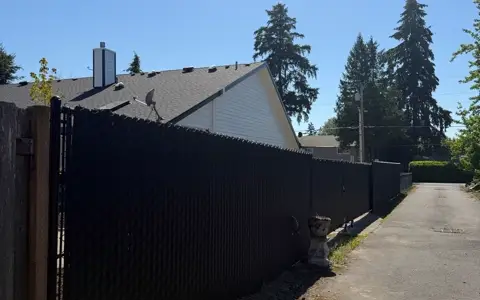
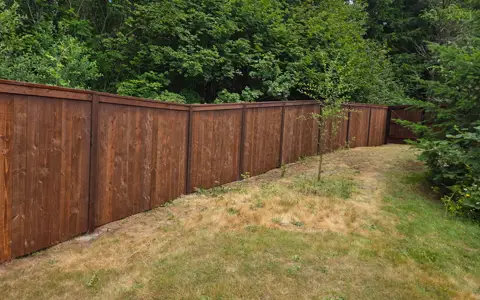
The photo below is a real Gorilla Works install in the Portland metro. No stock images.
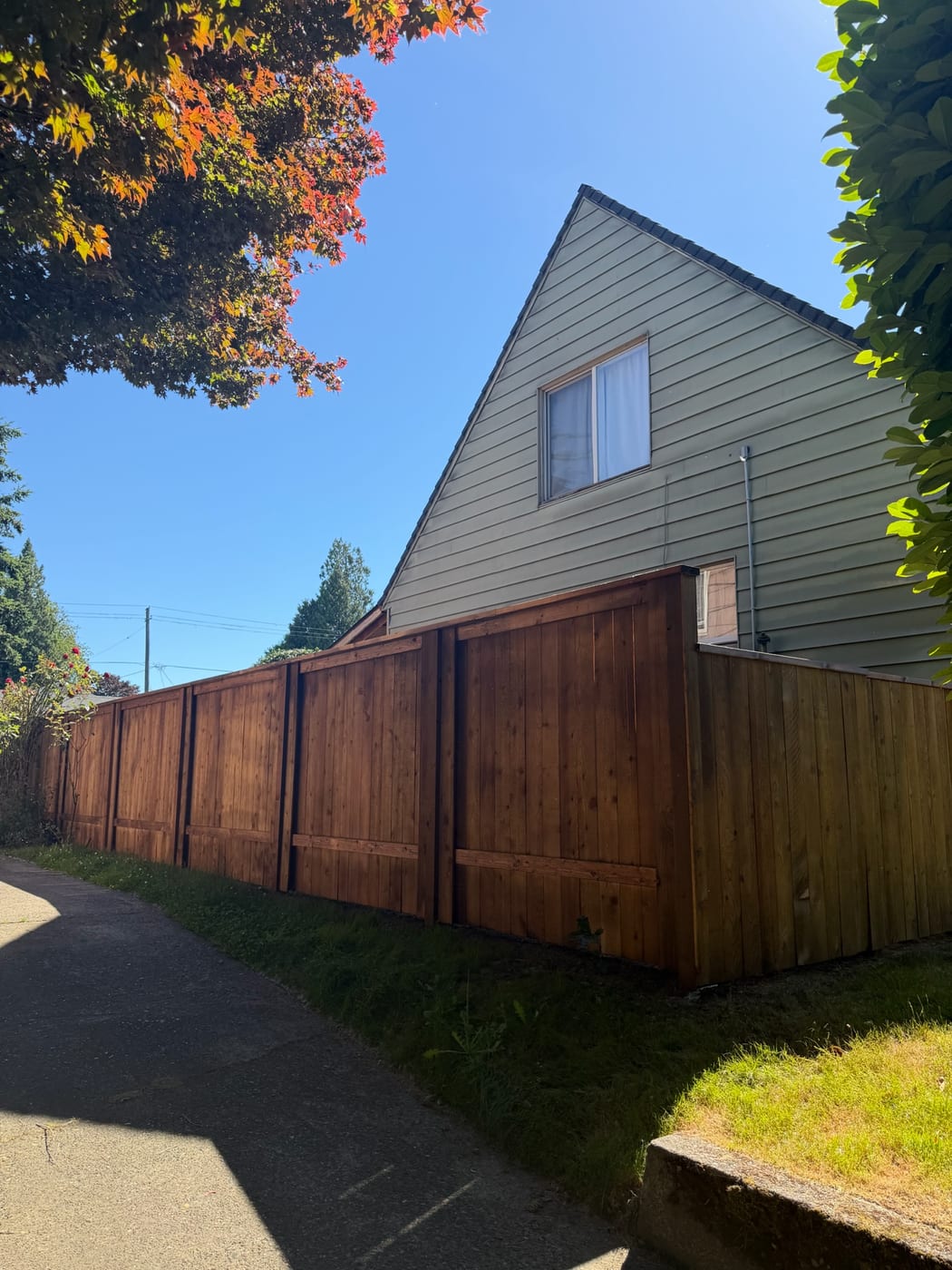
Where a Board on Board Fence Works Best
- Fences along a busy street or sidewalk, where you want the road screened out completely
- Back yards that are overlooked by a neighboring second story
- Any run where the far side is your own property, so nobody is looking at the back
- Homeowners who have had a standard fence open up with gaps as it dried out
Where It Is the Wrong Choice
We would rather talk you out of it than build you the wrong fence. Board on board is not the answer when the fence sits on a shared property line and the neighbor is going to look at the back of it every day. That is what the good neighbor style exists for, and starting that conversation badly costs more than the fence does.
It is also the wrong pick if you want to keep a view or keep light in a small yard. A board on board fence is a solid wall by design. If the goal is to define the boundary without closing the yard in, a hog wire fence does that job far better.
Specs and Standards
- Grade 1 or better cedar on every install, not an upsell
- Stainless steel fasteners throughout, so nothing rust-streaks down the boards
- Heavy-duty pressure treated posts, or PostMaster steel posts with a limited lifetime manufacturer warranty, set for Northwest ground
- Kick board along the bottom on request, which also stops digging
- Every install crew is led by an installer with 5+ years of experience
- Old fence tear-out and haul-away, priced per foot on your written estimate
- Usually starts 3 days to a week after you sign
- Limited 3-year workmanship warranty
Worried about the posts rather than the boards? The post is the part that fails first on most fences, and a wood fence built on steel posts solves it without changing how the fence looks.
Want a Fence Nobody Can See Through?
Tell us about your yard. We will measure the run, check your city's height rules, give you one written price and tell you honestly whether board on board or good neighbor fits your line. Free quotes, no pressure.
Get a Free QuoteTrusted by Families Across Portland & Vancouver
From clean installations to long-lasting quality, homeowners choose Gorilla Works because we do things the right way, with honesty, care, and craftsmanship that speaks for itself. Here’s what people are saying about working with our team.
★★★★★ Excellent 4.9 · 93 Google reviews
These men were so very professional, attentive to EVERY detail I asked of them, along with their more than competent installation know how. I had requested a couple of change orders be made and my crew was immediately on task. My fencing was completed in one day with time to spare. These men moved through my project speedily and with total care! Wonderful experience working with Gorilla Works! I hope to have them back soon!
Great Experience with Gorilla Works. Would give the team 11/10 stars for quality. Professional crews who know what they are doing. Thank you Anton and Alvin!
Beautiful installation on a cedar fence. Quick and responsive.
Amazing business that feels like family! Hard working and always goes to extra mile to make sure their customers are taken care of!
Gorilla Works did an amazing job with my new privacy fence. It turned out even better than I hoped for. Because the fence is so beautiful, I’m going to need to quit neglecting my yard and bring it up the beauty and quality of the fence. Highly recommend them. Pricing was really good, and they were very even able to start and get done in a shorter timeframe than anticipated.
Our newest Google reviews. See all 93 on Google
Frequently Asked Questions
Have questions about materials, pricing, or installation? Here are the answers homeowners ask us most.
Other Services We Offer in Portland & Vancouver
Ready to Upgrade Your Home’s Exterior?
Strong materials. Clean installations. Honest communication. It all starts with a quick quote.
Get a Free Quote