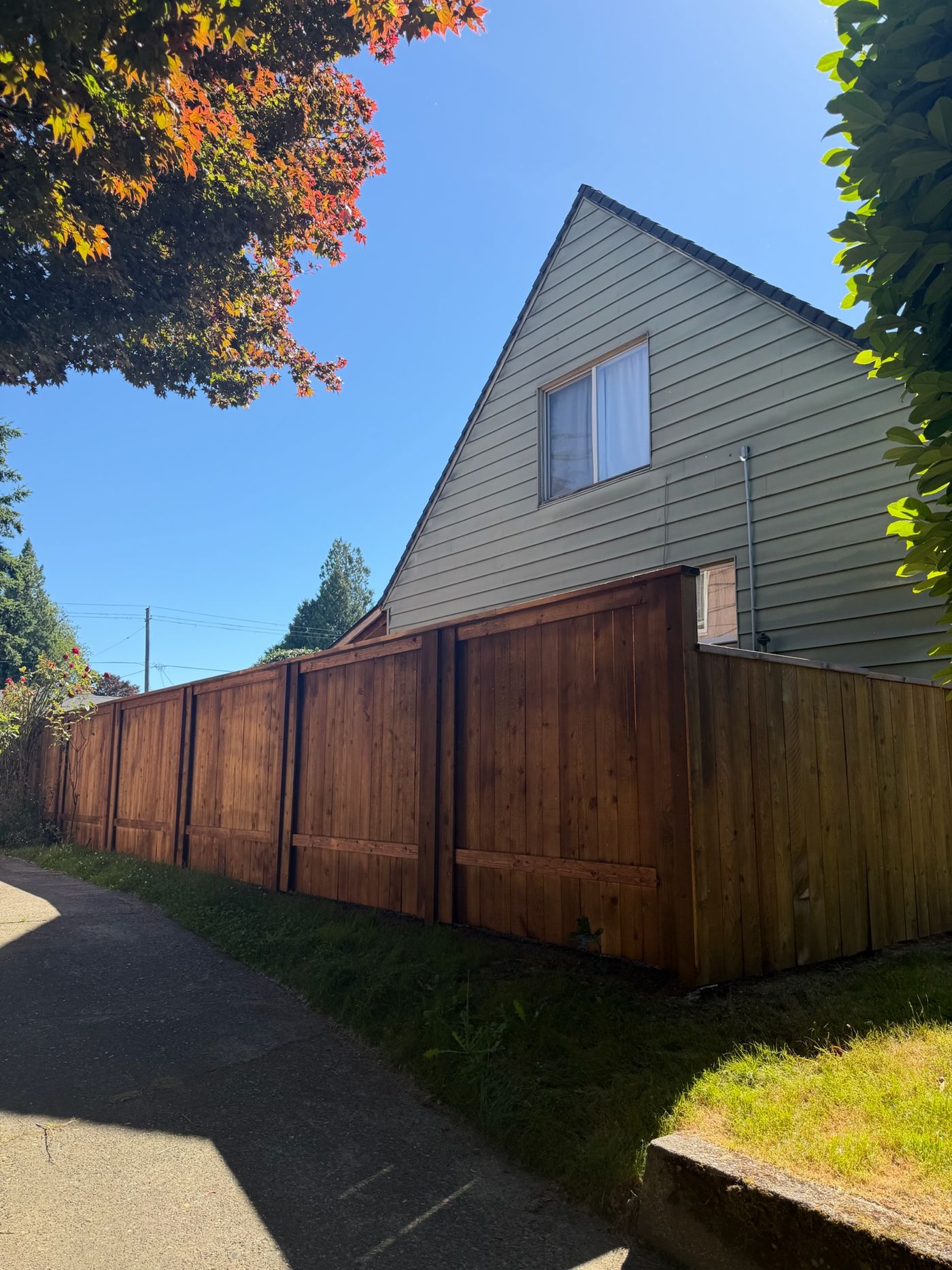
A wood fence with metal posts is a standard cedar fence built on galvanized steel posts instead of wooden ones. The cedar you see stays cedar. The steel is structural only, and on an in-line post system it gets covered with matching cedar, so from either yard it still reads as a wood fence.
That last part is the question almost every Portland homeowner actually asks first, so we will start there instead of burying it.
If you already know what you want, we handle fence installation across Portland, Vancouver, and the surrounding area.
Will It Still Look Like a Wood Fence?
Yes, if it is built with an in-line post system and finished properly. Here is the part most articles skip. There are two different ways to put metal in a wood fence, and they look nothing alike.
Surface-mounted posts sit on the outside of the fence line. The steel is visible as a vertical stripe down the fence, usually black. Some homeowners like the modern contrast. Many do not.
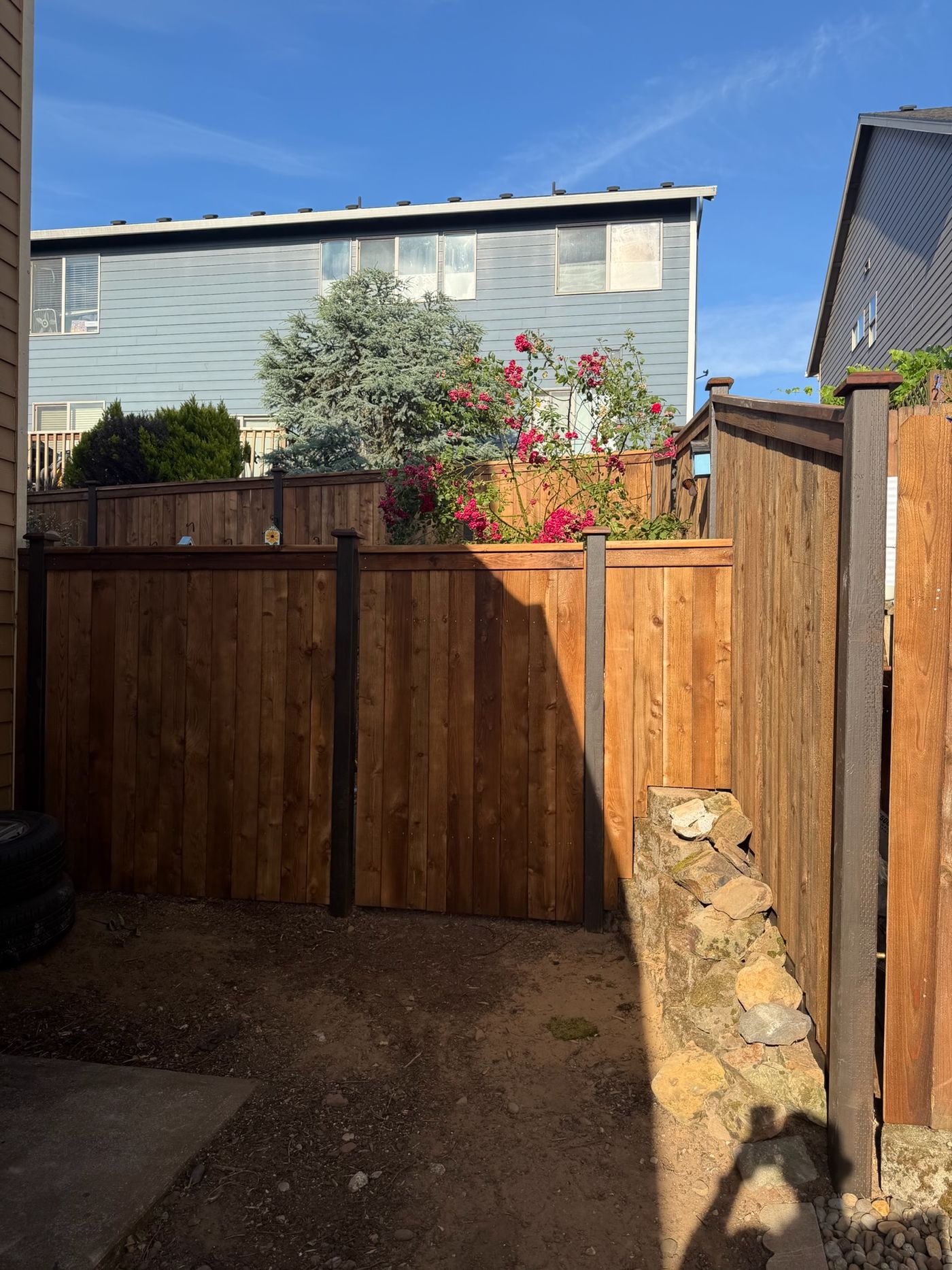
In-line posts sit inside the fence line, between the pickets. The picket run passes across the face of the post, and a matching cedar board covers the post entirely. Done this way, you do not see steel from either side. The manufacturer of the post system we use describes its line post as easily covered to preserve the natural beauty of the wood fence, and as easily covered, providing a true good neighbor fence.
That good neighbor phrase matters. Because the post is hidden on both faces, the fence looks finished from your yard and from your neighbor's, with no rail-and-post side to argue over.
More on that shared-fence-line look in our good neighbor fence guide.
The honest version: if a contractor installs surface-mount steel and does not cover it, you will see metal. That is a build decision, not a limitation of the material. Ask which system they use before you sign.
Why the Post Is the Part That Fails First
Walk a fence line that is failing and look at what actually broke. In most cases the pickets are still fine, sometimes even the rails. The post rotted at the soil line, the fence started to lean, and everything above it went with it.
Posts fail first because they are the only part of a wood fence buried in wet ground. Everything else gets to dry out.
What Actually Changed in 2003
You will read a lot of blog posts claiming pressure-treated wood was banned in 2003. That is not quite what happened, and the distinction is worth getting right.
According to the EPA, in December 2003 chromated arsenicals manufacturers voluntarily discontinued manufacturing chromated arsenicals-treated wood (CCA) for homeowner uses. It was not an EPA ban, it was a voluntary withdrawal from the residential market. CCA-treated wood is still approved for certain commercial uses like poles, posts, and pilings.
Why it matters to your fence: the older arsenic-based treatment was extremely effective at stopping rot in ground contact. The residential replacements are safer to handle, which is a genuinely good thing, but they generally do not last as long in wet soil. That is why an old fence post from the 1990s can outlast one bought a few years ago.
Why Portland Is Especially Hard on Fence Posts
Our climate is close to a worst case for buried wood, for four specific reasons:
- Long wet season. Months of steady rain keep soil moisture high through most of the year, so posts rarely fully dry out.
- Heavy clay soils across much of the metro hold water against the post instead of draining it away.
- Wet-dry cycling in summer swells and shrinks the wood, opening checks and cracks that let more water in.
- Shade and moss. Fir canopy and north-facing fence lines stay damp and grow moss, which holds moisture right at the surface.
A post that might last decades in a dry climate has a much harder job here. Published estimates for how long a treated wood post lasts vary and depend heavily on soil, drainage, and install quality, but they cluster in a consistent range: roughly 10 to 15 years for a modern pressure-treated 4x4 in ground contact, with 15 to 25 years achievable in favorable conditions. Pre-2004 CCA posts were commonly cited at 20 years and up.
Wood Posts vs Steel Posts, Side by Side
| Pressure-treated wood post | Galvanized steel post | |
|---|---|---|
| Rots in wet soil | Yes, this is the usual failure | No, steel does not rot |
| Warps or twists | Can warp, twist, and check | Does not warp |
| Typical service life | Roughly 10 to 15 years in ground contact here | Manufacturer backs it with a Limited Lifetime Warranty |
| Upfront cost | Lower per post | Higher per post |
| Long-term cost | Add a rebuild when the posts go | No post replacement cycle |
| Look | Wood, visible as part of the fence | Concealed behind matching cedar on an in-line system |
| Both sides finished | Depends on style | Yes, post hidden from both yards |
| Best for | Budget builds, well-drained sites, short-term ownership | Wet or clay soil, long-term ownership |
What Actually Goes Into a Steel-Post Cedar Fence
Specifics, since most pages on this topic stay vague. The post is pre-galvanized structural steel (G90 A653 SS Grade 50), 0.100 inch thick, with a 50 ksi yield strength and 65 ksi tensile strength. The manufacturer states it will never rot or warp and backs it with a Limited Lifetime Warranty.
The cedar matters just as much. We use Grade 1 or better cedar on every install, never builder-grade. Grade 1 has fewer knots and far less warping, twisting, and cracking, which counts for a lot in a climate that soaks and dries wood repeatedly. We do not charge extra for it.
Fasteners are stainless steel on every cedar install, standard. Cheaper fasteners rust and bleed black streaks down the boards within a year or two.
Then the details that decide how long it looks good. A top rail cap sheds water off the end grain and keeps boards from cupping, which is why it is our best-selling upgrade. A kick board along the bottom keeps pickets up out of wet soil and stops pets digging under.
Our fence installations carry a limited 3-year workmanship warranty, 5 years on select premium builds, plus a limited lifetime warranty on metal posts and 1 year of free gate adjustment.
When a Wood Post Is Still the Right Call
Steel is not automatically correct, and any contractor who tells you it always is has stopped giving advice and started selling. Wood posts still make sense when:
- The site drains genuinely well. Sandy or well-drained soil on a sunny, open fence line is a much easier environment, and a properly set treated post can last a long time there.
- You are not staying long. If you are selling in a few years, paying up front for a lifetime post benefits the next owner more than you.
- The fence is short or low-stakes. A garden divider does not carry the same load or consequence as a 6-foot privacy line.
- Budget is the binding constraint. A well-built wood-post fence in Grade 1 cedar with stainless fasteners is a genuinely good fence, and better than a steel-post fence built with builder-grade pickets and cheap hardware.
Where steel earns its keep: heavy clay, shaded or north-facing runs, long fence lines where a single leaning section ruins the look, and homeowners who simply do not want to do this again.
How We Build It
We have built fences across the Portland metro for more than 20 years, and over 100 of the fences our team installed are 20-plus years old and still standing.
On a steel-post build, the post is set in concrete, the cedar frame is fastened to the post, and a matching cedar board covers the post face so the finished fence reads as wood from both yards. Our installers are experienced fence specialists with a minimum of five years on the tools, background-checked, not day labor. We are licensed, bonded, and insured, and we offer financing with 12 months no interest.
Steel posts are also an option on an open-frame build. See our hog wire fence installation page.
Or browse every style we build in our fence styles guide.
Frequently Asked Questions
Can you use metal posts with a wood fence?
Yes. It is a standard build. The cedar pickets, rails, and cap attach to a galvanized steel post instead of a wooden one. On an in-line system the post is then covered with matching cedar so the fence still looks like wood.
Will I see the metal posts?
Not on an in-line system finished properly. The post sits within the fence line and a matching cedar board covers it, so it is hidden from both yards. On a surface-mounted system the steel is visible by design. Ask your contractor which one they are installing.
Do steel fence posts rust?
The posts are galvanized, which is a zinc coating that protects the steel. The manufacturer states the post will never rot or warp. Surface marks can appear on cut ends over time, which is why cuts and caps matter on install.
Are metal posts worth the extra cost?
It depends on your soil and how long you are staying. In heavy clay or a shaded, wet fence line, and if this is your long-term home, they usually are, because the post is the part that forces a rebuild. On a well-drained sunny site or a short ownership window, a quality wood post can be the smarter spend.
Do metal posts still need concrete?
Yes, we set them in concrete. The post material changes what rots, not the need for a properly set footing at the correct depth.
Can I put steel posts on my existing fence?
Usually not as a simple swap. By the time posts are failing, the rails and the picket bottoms are often compromised too. We will tell you honestly whether a repair or a rebuild is the better spend after looking at it.
Does a steel-post fence still work as a good neighbor fence?
Yes, and it is one of the better ways to build one. Because the post is concealed on both faces, neither yard is stuck looking at posts and rails.
Thinking about a fence that outlasts its posts?
We do free, no-pressure fence quotes for Portland-area homeowners, and we will tell you honestly whether your site actually needs steel posts.
Licensed, bonded & insured · Grade 1 cedar & stainless fasteners · 20+ years in the Portland area · Financing available
Gorilla Works proudly serves Portland, Gresham, Beaverton, Hillsboro, Tigard, Lake Oswego, Happy Valley, Milwaukie, Troutdale, Vancouver WA, and Camas WA. Call (971) 343-4964 or request fence installation.