Short answer: a kickboard, also called a rot board, is a horizontal board run along the bottom of a fence at ground level. It keeps the pickets up off the soil, closes the gap under the fence, and is designed to be the part that meets the dirt so the pickets do not have to. A mow strip is a band of concrete or pavers along the base of the fence that keeps grass and string trimmers off the wood. On a cedar fence in Portland, a kickboard is worth it on almost every job.
We build kickboards into most of the cedar fences we install around Portland. For how the rest of the fence goes together, see our Portland fence contractors page.
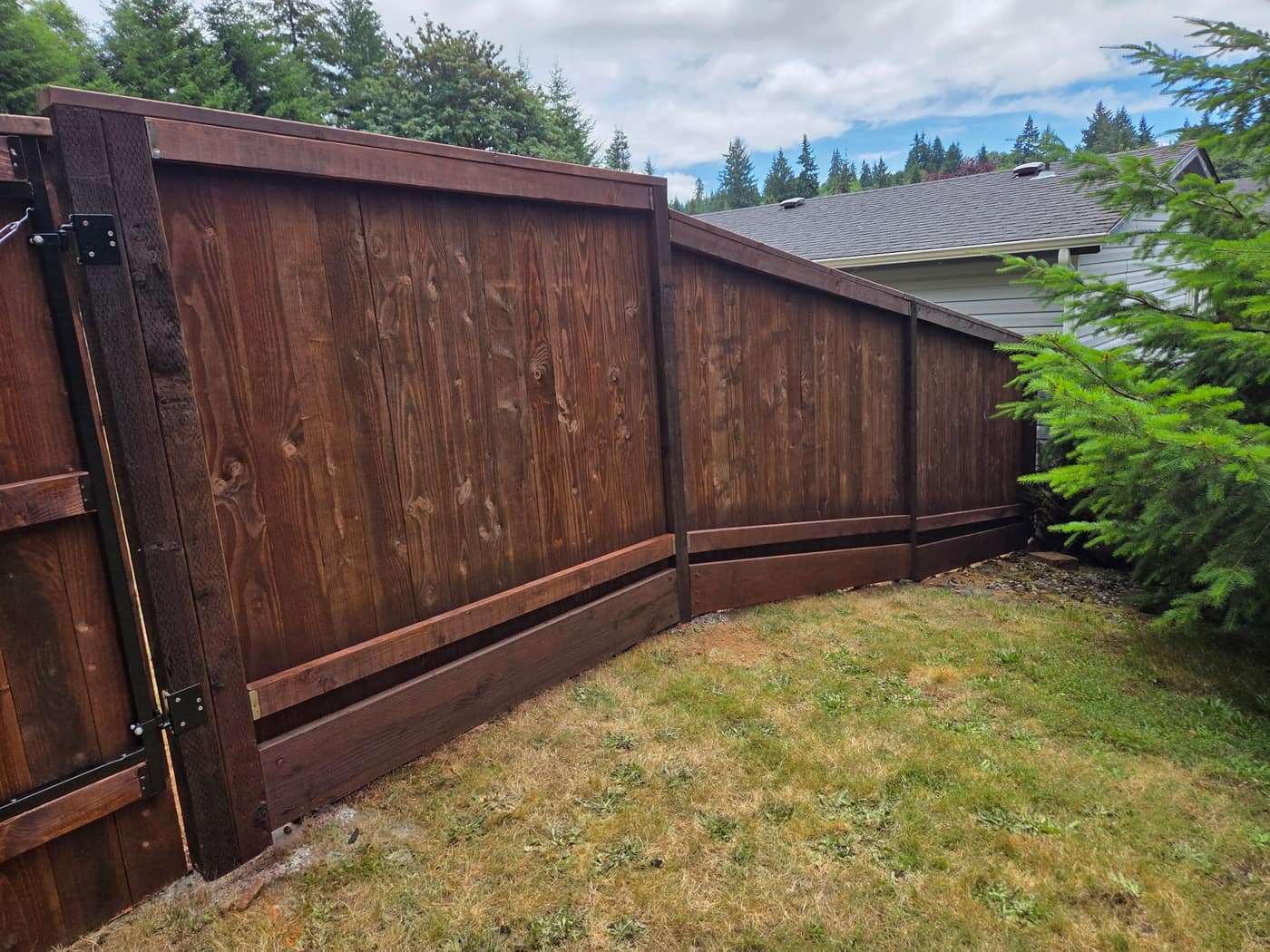
What is a kickboard on a fence?
A kickboard is a single board, usually 2x lumber, fastened along the bottom of the fence between the posts, running parallel to the ground. The pickets stop just above it or overlap it, so the kickboard, not the pickets, is what sits closest to the soil. It does three jobs at once.
- Keeps the pickets out of wet soil, which is where cedar rots first.
- Closes the gap under the fence, so dogs cannot dig under and small animals cannot squeeze through.
- Stiffens the bottom of each section so the pickets stay in line.
Is a rot board the same as a kickboard?
Yes, mostly. Rot board is the name for the same board, focused on the job of taking the rot instead of the pickets. Some builders use rot board for a board that sits in the soil and can be swapped out when it wears, and kickboard for any board along the bottom. In practice both names describe a sacrificial board at ground level that protects the rest of the fence.
What wood should a kickboard be?
Wood that is rated to touch the ground. The American Wood Protection Association puts fence pickets in its above ground category, Use Category 3B, but posts and anything else in ground contact belong in its ground contact category, Use Category 4A or higher. A kickboard that will sit in or against the soil should be pressure treated to that ground contact level, not cut from the same boards as the pickets. Cedar heartwood resists decay on its own, rated resistant to very resistant by the USDA Forest Products Laboratory, but it is not immune, and constant contact with wet soil is the hardest test there is.
If the look of a treated board bothers you, a cedar trim board can cover the face of it, or the kickboard can be stained to match or contrast with the fence. A darker kickboard is one of the simplest ways to make a fence look finished.
What is a mow strip?
A mow strip is a band of concrete, pavers or gravel laid along the base of a fence, usually a few inches wide on each side. The mower wheel rides on it, so you can mow right up to the fence without a string trimmer ever touching the wood, and grass stops growing against the boards and holding moisture there. It is optional, but on a lawn that runs right up to a fence it saves the bottom of the fence from years of trimmer damage.
| Detail | What it protects against | When to add it |
|---|---|---|
| Kickboard or rot board | Rot at the ground line, digging dogs, gaps under the fence | Almost every wood fence, especially with dogs or wet soil |
| Mow strip | String trimmer damage and grass holding moisture against the wood | Where lawn runs right up to the fence |
| Buried wire | Dogs that dig deeper than the kickboard | Serious diggers, often combined with a kickboard |
Should a fence touch the ground?
The pickets should not. Leave a small gap between the bottom of the pickets and the soil, and let a ground-contact kickboard close it. Pickets that sit in the dirt wick up water and rot from the bottom, which is the most common way a cedar fence fails early in a wet climate. On a sloped yard, a kickboard also closes the triangle gaps under a stepped fence.
A kickboard is one of the details that decides how long a cedar fence lasts. The others, from cedar grade to fasteners, are in our guide to the cedar privacy fence.
Frequently Asked Questions
Do I need a kickboard on my fence?
On a wood fence in Portland, it is worth it in most cases. It is the cheapest way to keep the pickets out of wet soil, and it stops dogs digging under.
Can you add a kickboard to an existing fence?
Yes. A kickboard can be fastened along the bottom between the posts of an existing fence, as long as the posts are solid. If the bottoms of the pickets are already soft, trim them back first so they sit above the new board.
How long does a kickboard last?
A ground contact rated board lasts far longer than a standard picket would in the same spot, and because it is a single board, it can be replaced without touching the rest of the fence.
Does a kickboard stop dogs from digging?
It closes the gap and stops casual digging. For a determined digger, add wire buried below the kickboard along the fence line.
Building for a dog? Our dog fence guide covers height, climbing and digging together.
Sources
Gorilla Works proudly serves Portland, Gresham, Beaverton, Hillsboro, Tigard, Lake Oswego, Happy Valley, Milwaukie, Troutdale, Vancouver WA, and Camas WA. Call (971) 343-4964 or request a fence quote.